James Amoo, Community Partner
Dec 18, 2025

Business operations are accelerating, and so are the underlying processes driving the motion. As a result, the analytics workflow has undergone a massive transformation. Data analysts have evolved from manually writing Python and SQL for every analysis task to using AI copilots and chatbots that can generate insights with simple prompts. This has significantly boosted productivity and reduced the time spent on routine tasks.
Unlike traditional copilots or chatbots, AI agents are autonomous. They don’t wait for you to ask a question or provide instructions. Instead, they continuously monitor your data, identify changes, and even generate insights on their own. They eliminate repetitive prompting and reduce human bottlenecks.
In this blog post, we’ll explore AI agents for data analytics. We’ll break down what AI agents are, how they differ from copilots and chatbots, and why they’re becoming essential in modern analytics workflows. We’ll also show you how to use Quadratic to build an AI agent for data analysis right from your spreadsheet environment.
What are AI agents?
AI agents are autonomous software programs capable of observing their environment, making decisions, and taking actions without human intervention. Unlike traditional copilots that require prompts, AI agents operate continuously to achieve specific goals. They monitor data, detect changes, and execute workflows automatically.
As organizational data grows in volume and complexity, analytics teams require systems that can react instantly to metric shifts and generate insights proactively. AI agents fill this gap by eliminating the delays and manual effort associated with human-driven analytics.
Agentic AI analytics refers to the integration of AI agents into data analysis and business intelligence workflows. Instead of analysts manually exploring spreadsheets and databases, AI agents autonomously analyze datasets, identify patterns, and surface insights.
Why AI agents are becoming central to modern analytics
Modern teams operate in real time. Decisions move faster, customer behavior shifts unpredictably, and datasets grow more complex by the day. Tracking these constant changes manually is no longer realistic.
AI agents process data at a speed and scale no human team can match. Today, data is produced every second, not daily or weekly like it used to be. Customer interactions, transactions, system logs, marketing campaigns, and operational metrics evolve continuously. Instead of waiting for analysts to refresh dashboards or rerun SQL queries, AI agents monitor data streams in real time and trigger analysis the moment something shifts.
For years, meaningful data insights were limited to people who could write Python, SQL, or use specialized BI tools. This created bottlenecks and kept many teams from leveraging data effectively. A data analytics AI agent can break down these barriers by summarizing datasets in plain language, explaining trends, and surfacing insights automatically. This democratizes analytics across the organization while also empowering technical users, non-technical employees, and even citizen developers to self-serve analytics.
Every organization ultimately works with data for a single reason: to make informed decisions. All the data cleaning, querying, modeling, and visualization are just a means to that end. Now imagine if AI agents could handle all of that heavy lifting and even help recommend or automate the decisions themselves. From prioritizing customers to restocking inventory to optimizing campaigns, AI agents can automate the workflows to drive better outcomes.
AI agents also excel at uncovering patterns and insights humans may overlook. Analysts are great at asking questions, but they’re limited by time and insufficient context. AI agents have no such constraints. They never stop analyzing and continuously scanning large datasets for new trends.
Agentic analytics vs traditional data analytics
Let’s take a closer look at how agentic analytics differs from traditional data analytics. Understanding these distinctions will help you evaluate whether autonomous analysis is the right fit for your workflow.
- Traditional analytics: This method requires manually writing Python code or SQL for data analysis. It is usually restricted to analysts who possess a certain level of technical expertise. Generating insights can take days or even weeks, depending on data complexity. For fast-moving businesses that need rapid and continuous insights, relying solely on this method may not be sustainable.
- AI analytics: AI analytics involves the use of machine learning models or copilots for AI spreadsheet analysis. While these tools automate much of the technical work, they still depend on constant human input. Analysts must prompt the system with natural language queries to explore datasets or generate insights. In other words, the analysis becomes faster, but not autonomous, because every step still requires a human to ask the next question.
- Agentic analytics: This approach uses AI agents to execute end-to-end analysis workflows without any human intervention.
The right approach depends on your business needs and the scale of your data operations. AI-assisted analytics works well for teams that prefer hands-on control or operate with smaller datasets. However, organizations seeking fully autonomous and continuous analysis will benefit far more from adopting agentic analytics.
What can you do with AI agents in data analysis?
We’ve discussed AI agents and how they’re important to modern analytics workflows. In this section, we’ll discuss some of the capabilities of AI agents in data analysis:
- Autonomous data cleaning: AI agents can autonomously clean datasets without any manual intervention. They can detect missing values, standardize formats, remove duplicates, and perform other routine data quality tasks. This eliminates the need to repeatedly prompt an assistant with instructions like “Please standardize this data” or “Remove duplicates.” As your data evolves, AI agents continuously and automatically maintain cleanliness.
- Real-time data monitoring: AI agents can continuously monitor key metrics, instantly detect anomalies, and identify unexpected spikes or drops. They act as a 24/7 digital assistant by keeping constant oversight of your systems. This is especially valuable in fields like finance, where real-time data changes can have a significant impact and require immediate attention.
- Automated report generation: AI agents can automatically generate and customize reports tailored to your needs. They can pull data, create visualizations, and produce insightful summaries without manual effort.
- Predictive analytics: AI agents can automatically build, retrain, and update predictive models as new data comes in. This allows them to forecast future trends, anticipate, and even suggest actions you can take ahead of time. For example, an analytics AI agent could predict a drop in customer retention and recommend targeted email campaigns, or forecast inventory shortages and suggest restocking levels before problems arise.
- Conversational analytics: Users can ask questions about their data in simple natural language, and AI agents can accurately interpret those questions and respond instantly with contextual insights. This includes summarizing complex datasets in plain English, generating concise data briefs, and explaining the trends or patterns driving numbers.
Benefits of agentic AI for data analysis
Let’s discuss some of the benefits of using agentic AI in analytics:
- Faster insights: AI agents dramatically shorten the time between data generation and insight. Instead of waiting hours or days for manual analysis, they process massive datasets within seconds, giving teams the ability to make informed decisions almost instantly and move with the pace of the business.
- Scalability: AI agents scale effortlessly. They can take on growing workloads without slowing down or requiring additional training, making them suitable for organizations managing large datasets.
- Reduced costs: AI agents help reduce costs by automating repetitive tasks. This allows businesses to allocate resources more efficiently and focus human effort on areas that require strategic thinking.
- Self-service analytics: Users can independently access and explore their data without having to learn Python or other programming languages.
How to create AI agents for data analysis
In this section, we’ll walk through how to create and use AI agents for analytics tasks such as data cleaning, summarizing reports, and more. We’ll be using Quadratic for this.
Quadratic is an agentic AI data analysis tool that allows you to create, deploy, and interact with AI agents directly inside your spreadsheet. Whether you prefer traditional analysis using Python and SQL, AI-assisted querying, or fully autonomous agent workflows, Quadratic provides an all-in-one environment to support all three.
Let’s see how we can create a data analysis AI agent that autonomously cleans our dataset. Here’s the sample dirty dataset we’ll be working with:
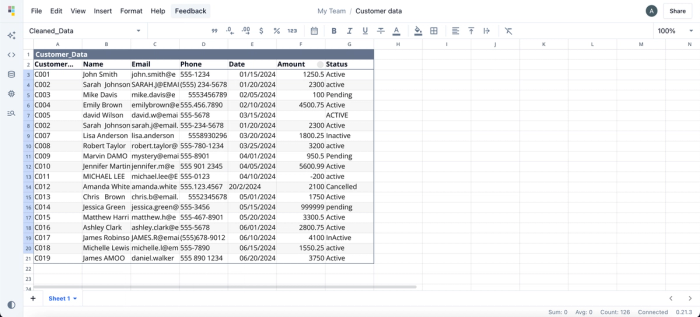
In this dataset, we have several issues like duplicate records, invalid entries, inconsistent date formats, mismatched phone number formats, and unnecessary whitespace. Instead of cleaning these manually, we can simply ask Quadratic AI to fix them. Here:
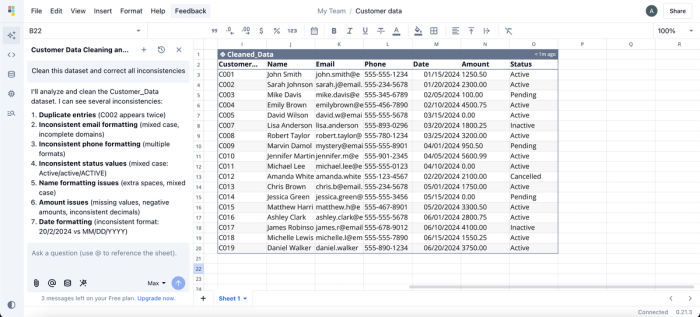
We simply ask Quadratic AI to “Clean this dataset and correct all inconsistencies”. Once the data is cleaned, Quadratic can function as an autonomous agent by continuously monitoring the spreadsheet for new or changed values. Whenever dirty or inconsistent data appears, the agent automatically cleans and standardizes it. This eliminates the need to re-prompt or repeat instructions.
Quadratic allows you to create AI agents for other use cases like summarizing data, building predictive models, transforming data, and more.
Conclusion
AI agents are rapidly becoming a cornerstone of modern data analytics. Teams that want to move faster, uncover insights sooner, and operate with greater precision need to position themselves at the forefront of this shift.
In this blog post, we explored what data analysis AI agents are, how they differ from traditional analytics methods and chatbots, the unique capabilities they bring to data workflows, and the benefits they offer to organizations operating at scale. We also demonstrated how you can build an AI agent for data analysis directly inside your spreadsheet using Quadratic.
