Table of contents
For many Sales Operations Managers and Revenue Operations analysts, the concept of spreadsheet automation often stops at the CRM level. You have triggers that move a deal stage from "Qualified" to "Proposal," and perhaps sequences that send emails when a lead score hits a certain threshold. Yet, despite these systems, the weekly forecast meeting remains a manual struggle. You likely spend hours exporting CSVs, fixing broken formulas, and trying to reconcile why the "Pipeline Value" on the dashboard doesn't match the reality of the sales floor, a challenge exacerbated by the fact that the average company experiences significant forecast inaccuracy.
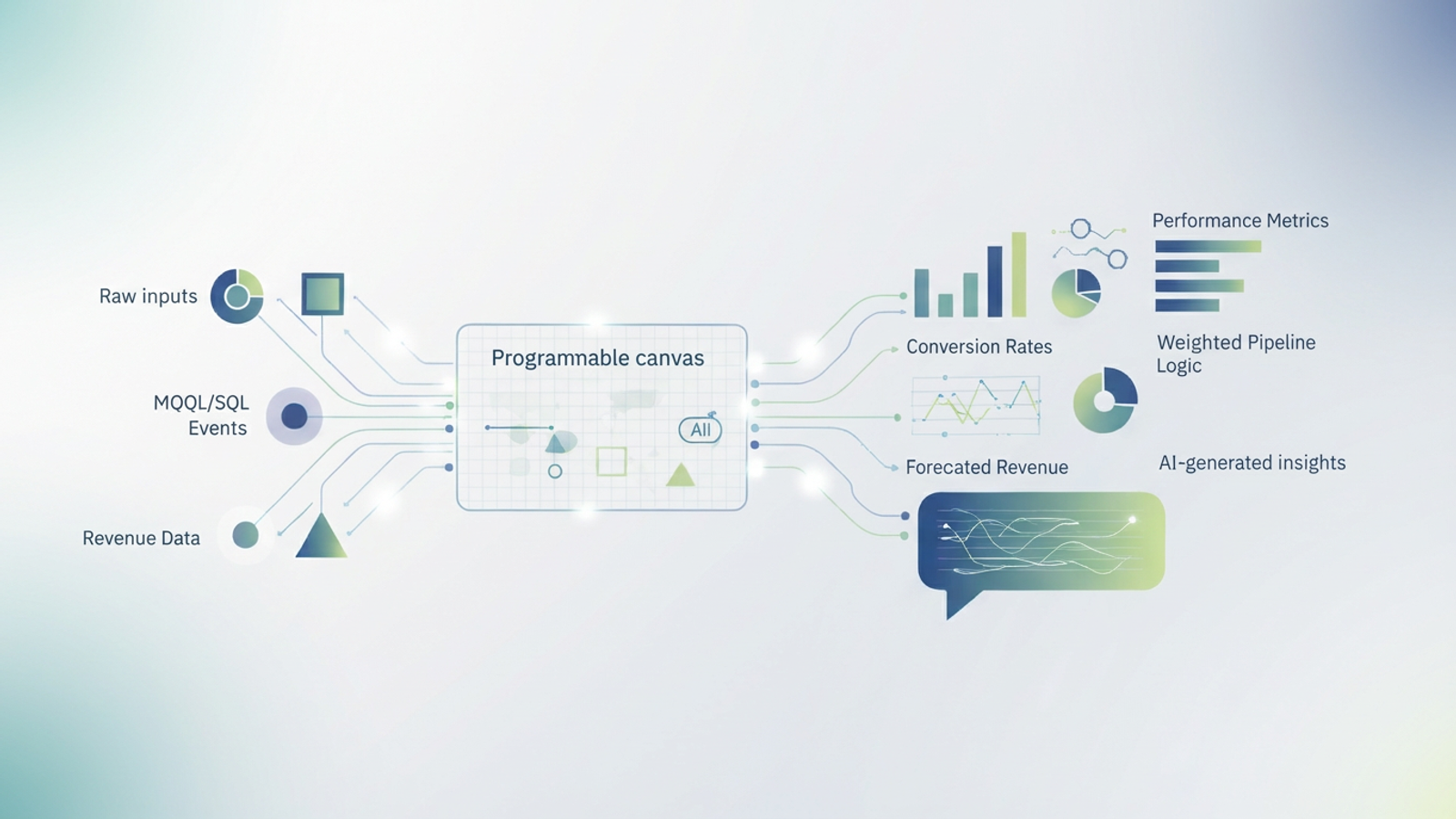
To solve this, we need to redefine the automated sales funnel. It is not merely a series of marketing emails or CRM triggers. A truly automated funnel is a data system that automatically ingests raw inputs, cleans inconsistencies, calculates complex metrics, and reports on pipeline health without human intervention, often facilitated by a robust sales funnel calculator. True sales funnel automation requires a flexible environment—one that moves beyond rigid CRM dashboards and allows for programmable data cleaning and narrative generation. By moving this workflow into a programmable canvas like Quadratic, a python spreadsheet, you can transform a static report into a self-updating engine that drives decision-making.
Why standard sales funnel automation tools fall short
If you search for sales funnel automation tools, the results are often dominated by expensive SaaS platforms or generic marketing plugins. While these tools are excellent for execution—sending emails or scheduling calls—they often fail at the analytical layer required by complex sales teams.
The first issue is rigid logic. Most CRMs lock you into their specific formulas for probability and forecasting. If your business model requires a weighted pipeline based on historical win rates rather than rep intuition, standard dashboards often cannot accommodate that complexity without heavy customization.
The second, and perhaps more pervasive issue, is messy data. The phrase "garbage in, garbage out" is the bane of every RevOps professional. Most automated sales funnel software assumes the data entering the system is perfect. In reality, lead sources are misspelled, tags are inconsistent, and deal sizes are entered with varying currencies, highlighting the importance of robust CRM data hygiene best practices. Finally, there is the "so what?" gap. A standard dashboard can show you that pipeline volume dropped by 10%, but it cannot explain why. It leaves the narrative interpretation entirely up to the user, which introduces bias and delays action.
Step 1: Ingesting and cleaning data (the self-cleaning layer)
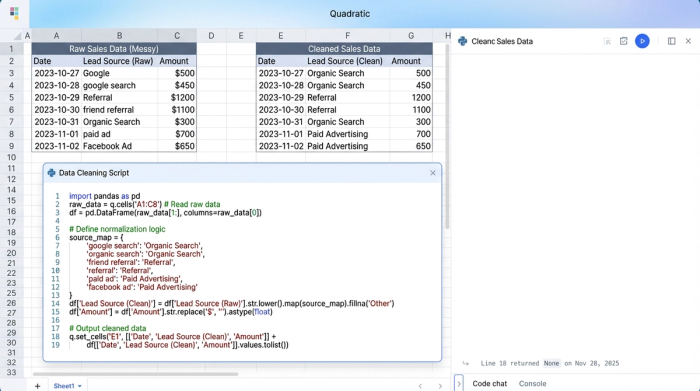
The foundation of a reliable forecast is a "self-cleaning" data layer. In a traditional spreadsheet, this involves manually finding and replacing text strings every time you import a new report. In Quadratic, you can automate this process using Python directly within the grid.
The workflow begins by connecting to your live data sources—whether that is a direct database connection to your data warehouse or an API pull from your CRM. You ingest raw tables for Leads, MQL/SQL events, and Revenue outcomes. However, raw data is rarely ready for analysis.
This is where the marketing automation sales funnel data often breaks down. For example, your "Lead Source" column might contain "LinkedIn Ads," "LI_Ads," and "Social - LinkedIn" all referring to the same channel. By using a Python code cell in Quadratic, you can write a script to map these variations into a single, normalized category called "Paid Social." Because this logic lives in the code, it runs automatically every time the data updates. This ensures that when you calculate conversion rates later, the denominator is accurate, and you don't have to spend your Monday morning manually cleaning rows.
Step 2: Calculating metrics with flexible logic
Once the data is normalized, the next step in understanding how to create an automated sales funnel is establishing metrics that reflect reality, not just optimism. Standard spreadsheets force you to rely on fragile chains of VLOOKUPs. In Quadratic's SQL spreadsheet, you can query your cleaned dataframes using SQL directly in the sheet to build dynamic metrics.
One critical metric to automate is the Weighted Pipeline. Instead of relying on the default percentages provided by your CRM, you can use SQL to perform SQL data analytics and calculate the actual historical win rate for each deal stage over the last rolling 90 days. You then apply this real-world probability to the current open pipeline to get a forecast that is based on data, not gut feeling, a core component of predictive modeling and analytics.
Another essential metric is Sales Velocity, which measures how quickly revenue moves through your pipeline. The formula—(Opportunities × Deal Value × Win Rate) / Sales Cycle Length—can be difficult to maintain in static sheets, especially when you want to segment it by cohort. With programmable logic, you can calculate velocity for Enterprise vs. SMB segments instantly, allowing you to see which cohorts are dragging down performance.
Step 3: Automating the narrative with AI
The most significant evolution in modern analytics is the ability to automate the explanation, not just the calculation. This addresses the "Narrative Gap" where stakeholders see the numbers but don't understand the context.
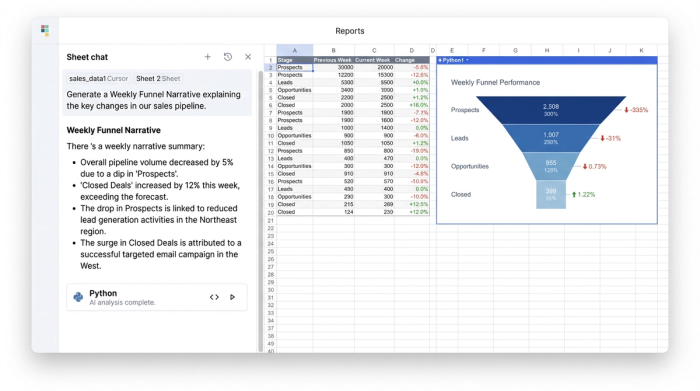
In this workflow, you utilize Quadratic’s AI integration, a powerful chatgpt alternative, to act as an always-on analyst. Instead of writing a weekly email explaining why the forecast dropped, you can prompt the AI to analyze your cleaned data tables. The AI can generate a "Weekly Funnel Narrative" that highlights specific changes, such as a drop in top-of-funnel volume, a bottleneck in the proposal stage, or slippage in sales cycle time.
When looking for the best AI tools for sales funnel automation, it is important to distinguish between chatbots and analytical agents. Most tools are chat interfaces that sit on top of your data. In Quadratic, the AI lives inside the spreadsheet, reading the actual rows and columns you have processed. This allows it to produce a text-based executive summary that sits right next to your charts, providing immediate context to the numbers. This turns your automated sales funnels into stories that drive strategy, rather than just tables that report history.
Visualizing the data for drill-down
The final output of this process is a dashboard where Sales Data Visualization is paramount. In a Quadratic workbook, your visualization—whether it is a cohort analysis or a sales velocity trend line—sits directly adjacent to the code that generated it and the raw data that feeds it.
This proximity offers a drill-down capability that static dashboards lack. If a Sales VP questions a specific number in the forecast, you don't need to say, "I'll get back to you." You can click through from the high-level chart down to the specific deal-level rows to verify the data immediately. This transparency builds trust in the data and ensures that the conversation focuses on solving sales problems rather than questioning the report's accuracy.
Summary: Building a funnel that works for you
An automated sales funnel is more than a dashboard; it is an end-to-end data flow. It starts with ingesting raw information, passes through a self-cleaning Python layer, undergoes rigorous SQL-based calculation, and concludes with an AI-generated narrative that explains the "why" behind the performance.
For Sales Operations professionals, the goal is to stop fixing broken CSV exports and start building a system that works for you. By adopting a programmable approach in Quadratic, you can ensure your forecasts are accurate, your insights are timely, and your time is spent on strategy rather than data maintenance.
Use Quadratic to build an automated sales funnel
- Automate raw data ingestion and cleaning using Python scripts directly in the grid, eliminating manual CSV fixes and ensuring consistent data from all sources.
- Calculate complex, custom metrics like weighted pipeline and segmented sales velocity with flexible SQL queries, moving beyond rigid CRM formulas.
- Generate automated narratives and executive summaries using built-in AI, explaining the "why" behind performance changes directly from your cleaned data.
- Visualize sales data with drill-down capabilities, linking charts directly to the underlying code and raw data for instant verification and trust.
- Centralize your entire sales funnel analysis into a single, programmable environment, freeing up time from data maintenance for strategic decision-making.
Ready to build a truly automated sales funnel? Try Quadratic.
