
Managing datasets of historical and religious figures requires a unique blend of strict theological knowledge and modern data hygiene. Advanced AI data management solutions can significantly streamline this process. When dealing with ecclesiastical titles, the standards are incredibly high. Encyclopedias and authoritative religious bodies establish rigid rules for naming popes, saints, and martyrs. Knowing these rules is one thing, but applying them to a messy, real-world dataset is an entirely different challenge.
For data stewards and historians maintaining religious data archives, the gap between strict theological naming conventions and practical data cleaning can be daunting, highlighting the unique challenges faced by religious archives. This guide explores how to bridge that gap. We will look at a practical workflow for taking a raw, unstructured list of religious figures and transforming it into a fact-checked, publicly presentable registry using Quadratic.
The challenge of data stewardship in religious archives
The public and religious institutions expect absolute accuracy when it comes to historical records. Encyclopedias and authoritative bodies maintain strict naming conventions that must be respected to preserve institutional credibility. However, the reality of working with religious data archives is often far less pristine than the final published texts. Source lists frequently arrive loaded with messy numeric prefixes, varied naming conventions, and duplicate entries. A single figure might be listed in several different formats depending on the source material.
To resolve this, data stewards need more than a traditional spreadsheet. They need an environment that combines a familiar grid interface with the programmatic power to handle complex logic. Quadratic serves as the ideal workspace for this niche data stewardship. It allows users to leverage Python, SQL, and standard formulas in the same grid, making it possible to systematically clean and organize religious datasets without losing historical context.
Step 1: Cleaning and deduplicating the source data in Quadratic
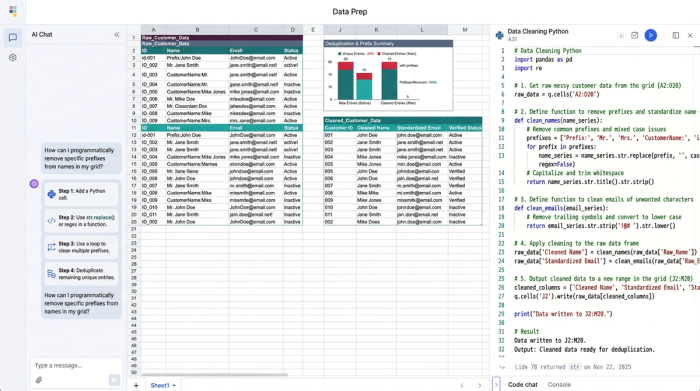
The first phase of creating an accurate registry involves importing the raw data into Quadratic. This initial data entry often benefits greatly from data entry automation, ensuring that even messy source lists are handled efficiently. In this real-world use case, the user started with a large, messy dataset containing saints, blessed individuals, and relics. The initial data was riddled with unwanted numeric prefixes and inconsistent formatting that made sorting impossible.
Using Quadratic, the user could programmatically clean the data rather than editing thousands of rows manually. By applying Python scripts directly within the spreadsheet grid, they easily stripped out the numeric prefixes and unwanted characters. Once the text was standardized, the next critical step was deduplication. Quadratic allows users to quickly identify and merge duplicate entries, ensuring that each historical figure or sacred relic is represented by a single, clean row of data.
Step 2: Categorizing saints, martyrs, and relics
With a clean baseline, the data must then be sorted into precise theological categories. This is a vital step before any honorifics can be applied. The user needed to establish specific baseline categories, following the official Catholic Church canonization process, including Saint, Blessed, Servant of God, Venerable, Martyr, Jesus, Relics, and Our Blessed Mother Mary.
Achieving this level of categorization requires careful cross-referencing. By bringing in supplementary texts compiled by hagiographes and historians, such as those found in the Database of Religious History, users can join these external sources within Quadratic. This ensures that every individual is accurately routed to their correct baseline category based on authoritative historical consensus before any further titles are considered.
Step 3: Assigning ecclesiastical titles with 100% certainty
This step represents the most critical intersection of theological accuracy and data workflow. Once the figures are categorized, the next task is appending accurate ecclesiastical titles such as abbot, apostle, bishop, confessor, doctor of the church, deacon, emperor, empress, evangelist, king, martyr, pope, priest, queen, religious, virgin, or widow.
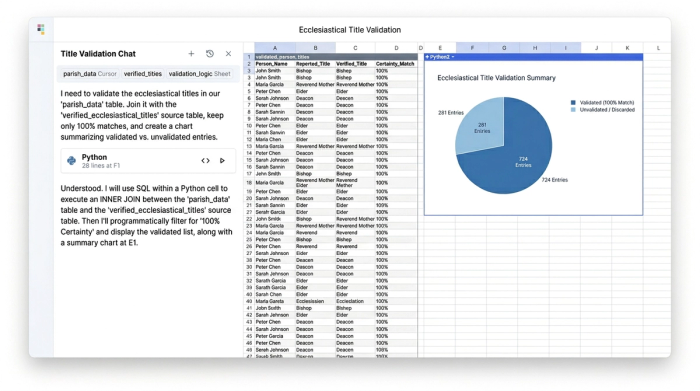
The golden rule of this workflow is strict constraint. With strong data validation in place, titles must only be added if they are 100 percent certain based on authoritative knowledge. There is no room for guesswork or debate. Quadratic excels in this exact scenario. Users can use SQL to join their newly cleaned dataset against a verified source of truth table right inside the spreadsheet. Furthermore, Quadratic makes it simple to programmatically flag and remove any uncertain, debatable, or ambiguous title assignments. By filtering out the anomalies, the final output retains only universally recognized ecclesiastical titles.
Building a fact-checked registry for public dissemination
The outcome of this meticulous workflow is a profound transformation. What began as a messy, unstructured list is now a clean, authoritative, categorized, and accurately titled registry.
This level of data integrity is absolutely vital for public-facing archives, scholarly research, and institutional credibility. Presenting incorrect information can undermine the authority of an entire archive. Because Quadratic keeps all the logic, code, and source data in one auditable workspace, researchers can easily trace how a specific title was assigned or why a duplicate was removed. It provides the programmatic precision required for high-stakes data stewardship while maintaining the accessibility and collaborative nature of a modern spreadsheet.
Conclusion
The journey from a messy, prefixed data source to a pristine registry of religious figures requires both historical reverence and modern technical capability. Managing ecclesiastical titles is not just about knowing theology. It is about having the right data environment to enforce those complex rules at scale.
By utilizing a platform that supports native code, database integrations, and rigorous data cleaning workflows, data stewards can ensure their registries meet the highest standards of accuracy. If you are dealing with complex, rule-heavy datasets that require absolute precision, try Quadratic for your next data cleaning and categorization project.
Use Quadratic to assign accurate ecclesiastical titles
- Programmatically clean messy religious data, stripping unwanted numeric prefixes and standardizing formats using native Python scripts within the grid.
- Efficiently deduplicate entries, identifying and merging records for historical figures and relics to ensure a single, accurate representation.
- Accurately categorize saints, martyrs, and other figures by joining supplementary historical and theological texts directly within the spreadsheet.
- Assign ecclesiastical titles with 100% certainty by using SQL to join your dataset against verified source-of-truth tables.
- Maintain absolute data integrity by programmatically flagging and removing any uncertain or ambiguous title assignments.
- Provide a fully auditable workspace where all cleaning logic, code, and source data are transparent and traceable for rigorous data stewardship.
Ready to manage your complex, rule-heavy datasets with precision? Try Quadratic
