
High-quality tutoring requires more than just subject knowledge. It demands a meticulously mapped curriculum perfectly aligned with official exam board specifications. For educators and instructional leaders, developing effective tutoring English lesson plans usually means wrestling with a chaotic mix of static PDFs, overlapping Word documents, and manual spreadsheets.
Managing multiple specifications across different tiers often results in administrative headaches rather than pedagogical excellence. However, by upgrading from traditional manual planning to building a programmatic, dynamic curriculum database using Quadratic, tutoring businesses can scale their operations with precision and ease.
The challenge of structuring English tutoring lesson plans
Educators know that pedagogical best practices rely heavily on curriculum mapping, pacing guides, and backward design methodology. These foundational strategies ensure students reach their academic goals systematically. Yet, when scaling a tutoring business, traditional methods quickly fall short, presenting various challenges in scaling educational improvements. Relying on manual documents makes it incredibly difficult to cross-reference multiple exam boards or standardize lesson structures across a growing team of tutors.
The specific challenge lies in ensuring comprehensive coverage of official specifications without accidental omission or redundant overlap. When managing English tutoring lesson plans across various tiers, a static document simply cannot provide the dynamic oversight needed to guarantee every syllabus point is covered accurately.
From static pacing guides to a dynamic curriculum database
The modern approach to building a pacing guide is no longer a qualitative exercise trapped in a word processor. Instead, it is a highly structured, quantitative process that lives in a dynamic spreadsheet or database.
This is where Quadratic changes the paradigm. By combining the familiarity of a spreadsheet with the power of a modern database, Quadratic provides the ideal environment for educators to build a scalable, data-driven framework. It allows instructional leaders to map lessons directly to official specifications and prepare the data for automated material generation, transforming a static syllabus into a living, programmatic tool.
Step-by-step: building exam board aligned lesson plans in Quadratic
1. Mapping multiple official specifications
The first step in this workflow involves breaking down official exam board specifications. A comprehensive tutoring curriculum must account for multiple boards, including AQA, Edexcel, OCR, Cambridge International, and IAL, spanning across tiers like GCSE, IGCSE, AS, and A-Level. The goal is to segment the syllabus into sequenced, one-hour lessons that logically group content. By doing this within Quadratic, educators ensure 100 percent coverage of all topics and subtopics from the official specifications, completely eliminating the risk of omission or overlap.
2. Structuring the data: CSV columns and directory paths
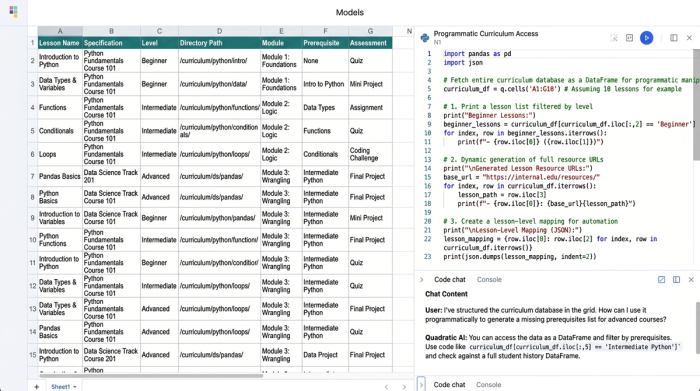
To make the curriculum truly scalable, the data must be rigorously structured. In Quadratic, users build a comprehensive CSV table utilizing specific columns to organize every detail. Essential columns include Lesson Name, Title, Directory Path (which incorporates the lesson number and specification reference), Specification URL, Reference Number, Subject, Level, and Next Lesson Details. Technical precision is paramount here. Maintaining clean data formatting, such as using consistent naming conventions and eliminating forward slashes in titles, is necessary to create precise directory paths. This level of organization turns a simple list of lessons into a structured database.
3. Backward-design the assessments
Integrating assessments is a critical component of any educational pacing guide. Quadratic allows users to systematically backward-design these milestones. For example, a common workflow involves spacing out assessments by dropping an entry approximately every four lessons to represent monthly tests. Operating within a spreadsheet environment makes this visual pacing mathematically precise. Tutors can easily track student performance and see the distribution of learning versus testing, ensuring students have adequate time to absorb material before being evaluated.
4. Formatting for AI-readiness and automation
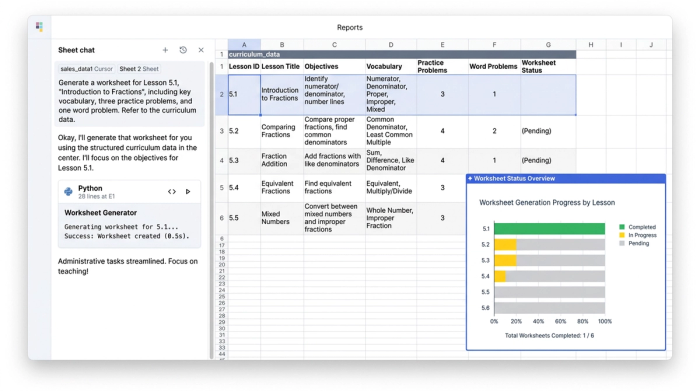
The ultimate return on investment for this highly structured approach is automation. By structuring the curriculum directory to exactly reflect the official numbering and topic order of the exam boards, the resulting CSV becomes a programmatic resource. This clean data is now AI-ready for advanced AI data management and automation, leveraging the numerous benefits of AI in education. Educators can feed this structured directory into AI tools to automatically generate corresponding teaching materials, such as targeted PowerPoints, worksheets, and homework assignments. This step drastically reduces the time tutors spend on administrative preparation, allowing them to focus entirely on teaching.
The result: a scalable, programmatic tutoring curriculum
What begins as a daunting, multi-board curriculum mapping task transforms into a clean, standardized database. By utilizing Quadratic, tutoring businesses achieve perfect exam board alignment, systematic assessment pacing, and total AI-readiness. There is no more overlapping content or missing syllabus points. Instead, instructional leaders have a reliable, programmatic foundation for their tutoring English lesson plans that can scale seamlessly as their business grows.
Ready to build your curriculum database?
If you are an instructional leader or tutoring business owner looking to scale your curriculum planning, it is time to move beyond static PDFs. Try Quadratic to map your next syllabus and experience the clarity of a scalable, data-driven approach to educational planning.
Use Quadratic to structure and scale your English tutoring lesson plans
- Map complex curricula: Consolidate multiple exam board specifications (AQA, Edexcel, OCR, etc.) and tiers (GCSE, A-Level) into a single, dynamic database.
- Ensure complete coverage: Break down syllabi into sequenced lessons, guaranteeing 100% coverage without omissions or redundant overlap.
- Streamline lesson organization: Structure lesson data with precise columns for names, directory paths, specification references, and next steps, eliminating chaotic manual documents.
- Integrate systematic assessments: Backward-design and visually pace assessments within your curriculum, ensuring balanced learning and evaluation.
- Automate material generation: Prepare your structured curriculum data for AI tools to automatically generate teaching materials like PowerPoints and worksheets, saving significant administrative time.
Ready to move beyond static PDFs and build a dynamic curriculum? Try Quadratic.
