
Designing an efficient HVAC system requires mastering both airflow physics and complex data management. For many engineering professionals, the first step is building an hvac duct calculator to manage project specifications according to industry standards.
However, as projects grow, teams often struggle to maintain accurate, consistent formatting across dozens of interconnected spreadsheet tabs. In this article, we will explore why standardizing calculation precision, specifically rounding up area and volume, is critical for accurate material estimation. We will also look at how modern tools like Quadratic outpace traditional spreadsheet software in achieving this consistency without the usual headaches.
The dual challenge of hvac duct size calculation
When you calculate hvac duct size, you are dealing with a multitude of variables. Engineers must account for dimensions, lengths, cross-sectional areas, surface areas, and volumes across a variety of shapes, including rectangular, circular, and oval ducts. But the math is only half the battle. A true hvac duct design calculator is rarely just a single formula on a blank page. Instead, it is a complex web of interconnected sheets representing different building areas, zones, and duct types.
This complexity introduces a significant risk of underestimation. In an hvac duct size calculation, rounding matters immensely. If a spreadsheet inadvertently rounds down a volume or surface area value, the resulting material estimates will be short. Underestimating the amount of sheet metal or insulation needed costs money, delays project timelines, and creates logistical nightmares on the job site.
Why traditional spreadsheets fall short
If you search online for a free hvac duct sizing calculator, you will likely find basic templates that work fine for a single room. However, these rudimentary tools lack the capability to handle multi-sheet project logistics for an entire commercial building. When estimators try to scale these basic templates in traditional spreadsheet software, they inevitably run into formatting and precision issues.
A common workaround in legacy spreadsheets is using global settings like "set precision as displayed." Unfortunately, this approach is notorious for causing dangerous cumulative floating-point errors over time. To standardize number formats and rounding logic across multiple sheets, users are often forced to write clunky VBA macros or rely on fragile 3D references. These workarounds break easily, leaving project managers to spend hours auditing cells instead of designing systems.
Building a better hvac duct calculator in Quadratic
To avoid the pitfalls of legacy software, modern engineering teams are turning to the best data science tools. Quadratic provides the ideal environment for building an interconnected hvac duct sizing calculator that handles complex math and large-scale data management with ease.
Consider a real-world scenario where a project manager needs a comprehensive hvac duct size calculator for a large commercial facility. The setup involves managing multiple sheets for different building areas, carefully separating the calculations for rectangular, circular, and oval ducts. In a traditional tool, keeping these sheets synced and accurately rounded is a chore, but in Quadratic, it becomes a streamlined, automated process.
Enforcing strict rounding rules across sheets
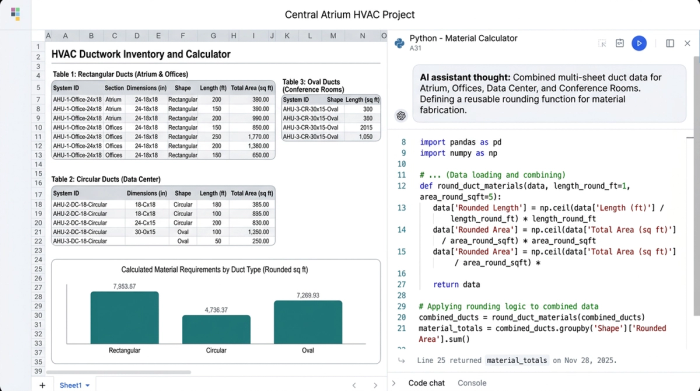
The core of a reliable duct calculation workflow is standardization. In Quadratic, users can seamlessly standardize and correct the rounding of key calculated values across their entire workspace. For material estimation, the specific logic required is rounding up cross-sectional area, surface area, and volume values to exactly three decimal places.
Because Quadratic allows for native Python, SQL, and advanced spreadsheet formulas in the same browser-based grid, applying this logic is clean and consistent. You can enforce a strict rounding rule at the calculation level for every duct type and building area. There is no need to rely on fragile VBA scripts or worry about unseen floating-point drift. The exact mathematical requirement is applied universally across all relevant sheets, ensuring that every square inch of material is accounted for.
Seamless summaries for project documentation
The ultimate goal of any engineering spreadsheet is to produce clear, actionable outputs. Because the rounding rules are strictly enforced at the calculation level in Quadratic, the summary sheets are perfectly accurate. These summaries aggregate data by building area, pulling in the precisely rounded volumes and surface areas from the individual duct calculation tabs.
This consistent presentation is vital. It supports accurate hvac system design, flawless material estimation, and highly professional project documentation. When stakeholders review the final numbers, they can trust that the totals reflect the true material requirements, completely free from the compounding errors that plague traditional spreadsheets.
Upgrade your duct calculator hvac workflow today
Engineering precision requires software precision. You should not have to fight your spreadsheet to ensure you have enough sheet metal for a job. While a simple hvac duct sizing calculator free download might help you size a single branch, professional building management requires the interconnected, precise data handling that only a modern platform can provide.
By upgrading your hvac duct calculator to Quadratic, you eliminate the risks of material underestimation and fragile macros. Quadratic empowers you to build professional engineering calculators that handle complex math, live data integrations, and multi-sheet logic seamlessly. Try Quadratic today to bring speed, clarity, and uncompromising accuracy to your next project.
Use Quadratic to calculate HVAC duct sizes
- Enforce precise rounding-up rules for cross-sectional area, surface area, and volume uniformly across all calculations, preventing material underestimation.
- Build interconnected HVAC duct calculators that seamlessly manage multiple sheets for different building areas and duct types (rectangular, circular, oval).
- Apply consistent calculation logic using native Python, SQL, or advanced formulas, eliminating fragile VBA macros and cumulative floating-point errors.
- Generate perfectly accurate summary sheets for project documentation, ensuring reliable material estimation and stakeholder trust.
Upgrade your HVAC duct calculation workflow for speed, clarity, and accuracy. Try Quadratic.
