
In modern daily fantasy sports and season-long leagues, reacting quickly to NBA fantasy injuries is where contests are won or lost. When a star player is ruled out, it triggers what analysts call an Injury Cascade. The most critical question is not just who is missing the game, but who absorbs their NBA usage rate and how that shift impacts the entire slate.
For years, players have faced a frustrating dilemma. On one hand, rigid black box lineup optimizers spit out generic rosters without explaining the underlying logic. On the other hand, performing predictive modeling and analytics with custom machine learning models in Python or R takes hours of coding that simply cannot be replicated every day before tipoff. Quadratic bridges this gap. As a next-generation spreadsheet, it provides a transparent, flexible workspace that combines visual familiarity with the analytical power needed to cross-reference daily availability, advanced player archetypes, and complex defensive matchups.
The evolution of NBA DFS: beyond traditional positions
Simply replacing an injured point guard with a backup point guard is an outdated strategy. The modern game is positionless, meaning usage and opportunity do not flow in a straight line down the depth chart, leading analysts to reclassify players beyond traditional positions.
Instead, the sharpest analysts focus on Advanced Player Archetypes. These skill-based taxonomies group players into specific roles, such as High-Usage Creators, Perimeter-Oriented Shooters, or Rim-Running Bigs. Using a basketball scouting report template can help you understand a player's true archetype and is the secret to unlocking massive value when a star player goes down. If a primary ball handler is out, the offense might shift entirely, funneling more isolation plays to a scoring wing rather than the backup point guard. Identifying these nuanced shifts requires a flexible analytical environment.
The problem with "black-box" lineup optimizers
Most daily fantasy players rely on automated optimizers that fail to explain why a specific player is chosen, highlighting the lack of interpretability in black box models. These tools act as closed systems, taking away your ability to trust the math or adjust the logic based on your own basketball knowledge. Alternatively, some enthusiasts read academic data science blogs but find the complex clustering models impossible to replicate on a daily basis.
Analysts need a tool where they can actually see the data, adjust the inputs on the fly, and instantly visualize the output. They need the power of a coding environment but the accessibility of a standard grid.
Building a custom workflow for NBA fantasy injuries in Quadratic
Quadratic is the ideal canvas for solving the daily puzzle of NBA fantasy injuries. A sports analyst can use the platform to evaluate yesterday's player rankings and apply them directly to today's slate. Because Quadratic allows you to bring Python, SQL, and standard spreadsheet formulas into a single workspace, you can map out the perfect lineup without losing visibility into your data.
Step 1: Ingesting the NBA daily fantasy injury report
The first step in any daily workflow is pulling in today's player availability. Quadratic connects directly to live data sources, allowing you to easily import the NBA daily fantasy injury report right into your spreadsheet.
Once the data is ingested, you can use a quick SQL query or Python script within the grid to filter out inactive players immediately. From there, you can cross-reference this updated availability with yesterday's player projections and Average Draft Positions. By having live data imports seamlessly integrated, you never have to waste time manually copying and pasting status updates.
Step 2: Mapping the injury cascade and usage spikes
When a star with a 30 percent usage rate sits out, those available shots and assists have to go somewhere. Instead of guessing who benefits, you can use Quadratic to build a dynamic Injury Cascade table.
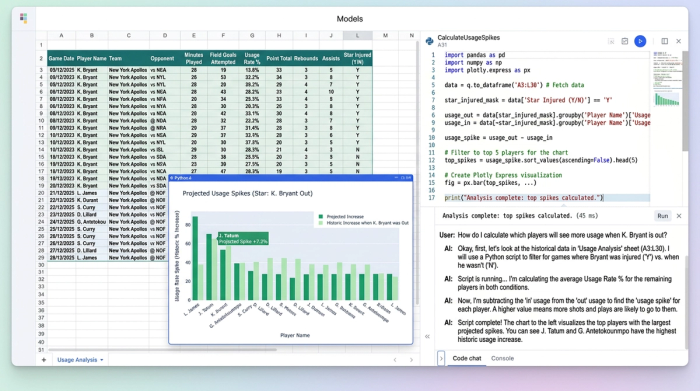
Triggered by the initial news from the NBA fantasy injury report, this table allows you to query historical data directly within the sheet. You can write a Python script in one cell to analyze past games where the star was inactive, revealing exactly which archetypes on the bench historically benefit from the absence. This transforms a guessing game into a mathematically sound projection of usage spikes.
Step 3: Cross-referencing defensive matchups by archetype
To refine your strategy, you must look at how the opponent defends specific types of players, understanding the value of defensive matchup data.
In Quadratic, you can easily integrate a Team Defense Scheme table alongside your player data. The infinite canvas allows you to drag tables next to each other and cross-reference these complex datasets. For example, you can filter the data to see that while Player X is in line for a usage spike today, the opposing team boasts a top tier defense against Perimeter-Oriented Shooters. This level of granular, archetype-based matchup analysis helps you avoid costly lineup traps.
Step 4: Date filtering and final lineup construction
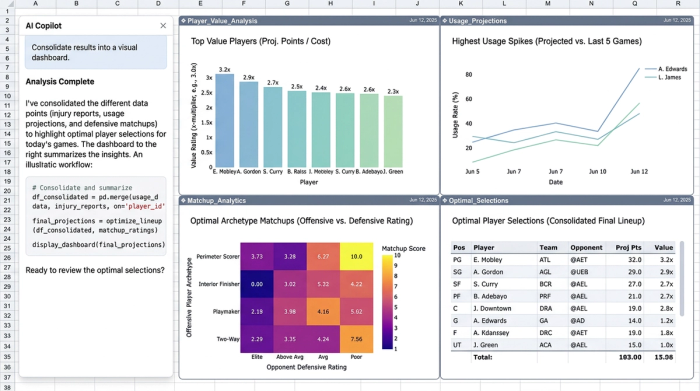
The final step brings all these disparate data points together. By applying strict date filtering using standard formulas or SQL, you ensure that only today's slate of games is analyzed.
The output is a clean, comprehensive visual dashboard built right in Quadratic. This dashboard highlights the optimal player selections based on a perfect storm of injury opportunities, archetype fit, and defensive vulnerabilities. Unlike the rigid output of a standard optimizer, this custom built view is entirely transparent. You can see the Python code next to the spreadsheet cell and understand exactly why a player is recommended.
Gain a competitive edge with transparent data
By combining raw data regarding NBA fantasy injuries with advanced archetypes and defensive profiles in a flexible environment, you can make highly informed decisions. Quadratic removes the friction of traditional data science tools while offering far more power than a basic spreadsheet. You get the analytical capabilities of a data scientist with the ease and visual clarity of a grid, empowering you to find the hidden value that wins contests.
Conclusion
Reacting swiftly and accurately to NBA fantasy injuries is the ultimate separator between casual fans and profitable DFS players. When you understand the underlying data, you can exploit usage spikes and favorable matchups before the rest of the field catches on.
It is time to stop relying on black box optimizers that hide their logic. Start building your own custom, transparent fantasy sports dashboards today. Sign up for Quadratic to bring your Python scripts, SQL queries, and live data into one unified spreadsheet, or explore a template to kickstart your daily fantasy sports workflow.
Use Quadratic to Master NBA Fantasy Injuries
- Ingest live injury reports instantly: Connect directly to data sources to pull in daily NBA fantasy injury reports, eliminating manual data entry and ensuring you always have the latest player availability.
- Analyze usage rate shifts with precision: Build dynamic "Injury Cascade" tables using Python scripts to identify exactly which player archetypes gain usage when stars are out, replacing guesswork with data-driven projections.
- Combine advanced analytics in one view: Seamlessly integrate Python, SQL, and spreadsheet formulas to cross-reference player availability, advanced archetypes, and complex defensive matchups on an infinite canvas.
- Visualize transparent lineup insights: Construct custom dashboards that clearly show the logic behind optimal player selections, allowing you to trust your strategy and make informed, on-the-fly adjustments.
- React quickly to daily changes: Leverage a flexible, powerful environment to rapidly adapt your strategy to the latest injury news and exploit value before the competition.
Stop relying on opaque optimizers. Build your winning NBA fantasy strategy with transparent data. Try Quadratic today.
