Managing industrial and heavy machinery maintenance is a complex operation. Workshop managers and fleet directors know that profitability often hinges on the accuracy of a single quote. However, the process of mechanical equipment repair is frequently plagued by disconnected workflows. When technicians rely on paper checklists on the shop floor while managers use isolated spreadsheets in the back office, shops struggle to maintain the key performance indicators for heavy equipment necessary to prevent lost profitability and operational friction.
To solve this, one workshop management professional transformed their quoting process by building a unified, data-driven engine inside Quadratic. By bridging the gap between the floor and the desk, they turned a fragmented system into a streamlined operation that protects profit margins and standardizes every repair.
The hidden costs of fragmented equipment repair workflows
Many maintenance shops treat inspections, cost estimation, and approvals as completely siloed steps. A technician might jot down notes on a clipboard, hand that paper to an automotive service writer, and wait for a manager to calculate the final numbers. This fragmented approach creates significant bottlenecks between the initial assessment and the final quote.
Relying on static templates and rigid systems introduces margin leaks at multiple stages. Technicians might miss critical failure modes because a generic paper checklist does not account for the specific machine they are inspecting. Meanwhile, managers might calculate equipment repair cost estimation using outdated pricing matrices stored in an old spreadsheet.
These traditional approval workflows create friction. Data must be re-entered manually, increasing the risk of human error. When the shop floor and the back office operate in different systems, workshop managers lose visibility, and the business ultimately loses money.
Bridging the gap: a dynamic approach to equipment repair
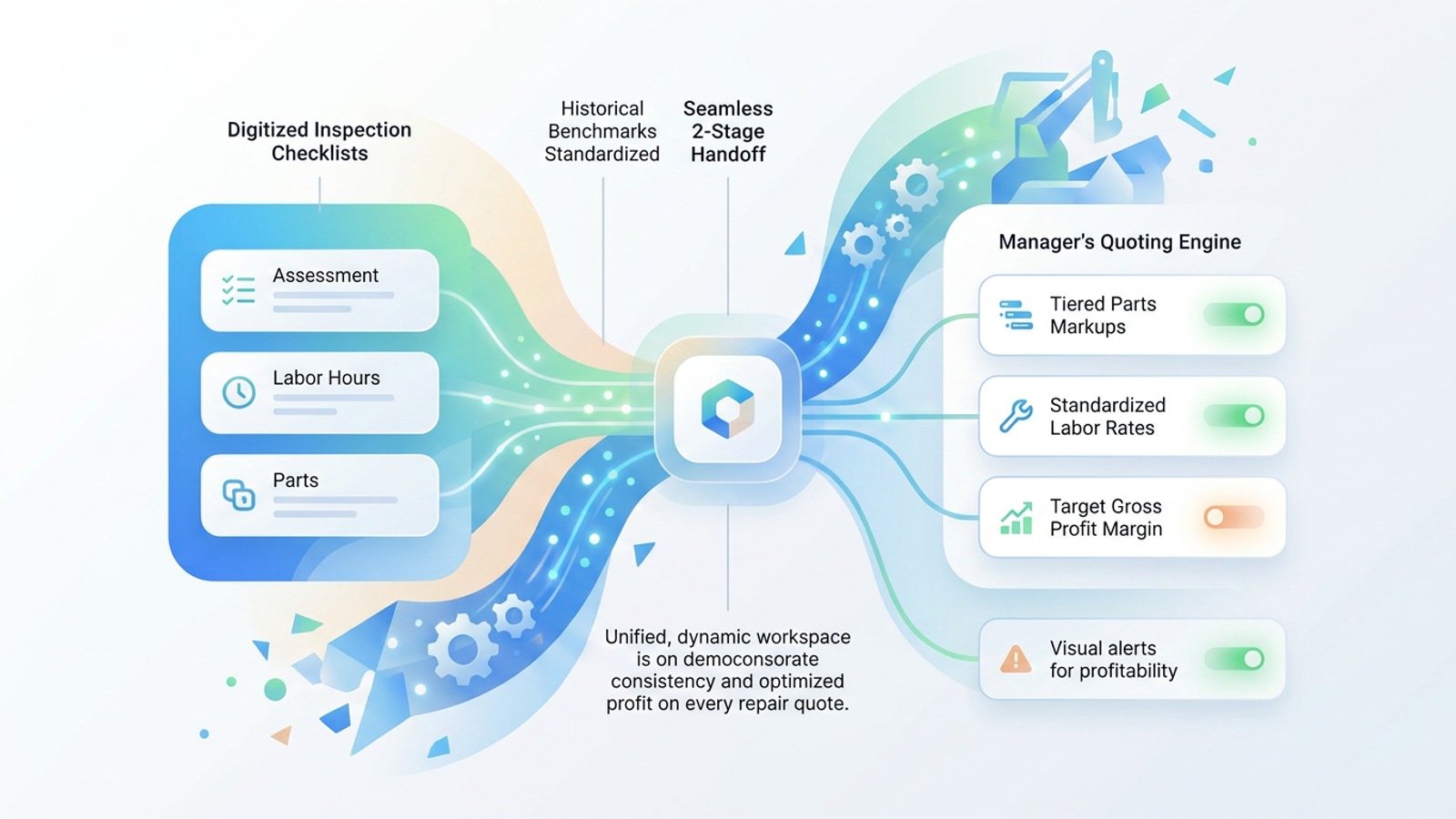
To eliminate these costly bottlenecks, the workshop manager turned to Quadratic to unify their entire process. Rather than juggling disconnected documents, they built a single, dynamic workspace that connects the technician's physical inspection directly to the manager's financial calculations.
This new approach to mechanical equipment repair centers on leveraging historical repair data. Instead of using generic paper forms, the manager created a suite of standardized, asset-specific digital forms. Whether a technician is looking at a hydraulic pump or a bulldozer, the form dynamically adapts to that exact piece of equipment.
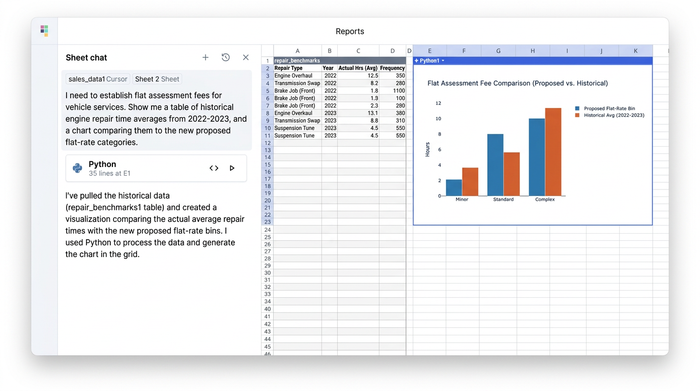
By shifting away from static PDFs, the workshop now relies on dynamic data. The Quadratic workspace actively pulls in historical benchmarks and recommends flat assessment fees based on past repairs. This creates a seamless, two-stage handoff that keeps everyone on the same page.
Stage 1: empowering technicians with digitized inspection checklists
The first half of this two-stage workflow takes place directly on the shop floor. This setup serves as the ultimate upgrade to a basic vehicle maintenance spreadsheet or the standard free equipment inspection checklists that many shops download and print. This setup serves as the ultimate upgrade to the standard free equipment inspection checklists that many shops download, print, and fill out by hand.
Using these customized digital forms, technicians can easily document their assessment findings, list required parts, and log estimated labor hours. Because Quadratic is a flexible workspace, technicians can also attach images directly to the assessment cells, providing visual proof of wear and tear or catastrophic failures.
Additionally, the forms include designated fields for tracking warranty details. This ensures that nothing is missed during the initial intake, preventing the shop from accidentally footing the bill for a repair that should be covered by the manufacturer.
Stage 2: the manager’s quoting engine for guaranteed profitability
The second half of the workflow happens in the back office. As soon as the technician completes the inspection, the manager receives the data in the exact same Quadratic workspace. Just as specialty contractors use custom fence quoting software to handle complex estimations, Quadratic allows workshop managers to apply their own custom-built rules instantly.
Unlike rigid, off-the-shelf repair cost estimating software that forces shops to adopt generic pricing models, Quadratic allows managers to apply their own custom-built rules instantly. The manager built specific financial mechanics directly into the spreadsheet to guarantee profitability on every job.
- Standardized labor rates: The system automatically applies the correct hourly rate based on the specific task, skill level, and fully burdened labor rate required, eliminating guesswork.
- Tiered parts markups: The manager implemented dynamic rules based on a structured parts markup matrix that adjusts the markup percentage based on the base cost of the part. These rules can even be linked directly to a stock control spreadsheet to ensure real-time parts availability and pricing are always accurate.
- Visual profit alerts: By setting a target gross profit margin, the manager used conditional formatting to create automatic warnings. If a quote falls below the required profitability threshold, visual profit alerts immediately notify the manager to adjust the pricing before sending the estimate to the customer.
Why this 2-stage workflow beats traditional methods
By setting up a two-stage workflow in Quadratic, the workshop manager achieved outcomes that standard spreadsheets and paper forms simply cannot match. The seamless connection between the floor and the office transformed the entire business.
- Efficiency and speed: Technicians and managers no longer waste time re-entering data from paper to computer. The seamless digital handoff drastically speeds up the approval process, getting quotes to customers faster.
- Consistency: With asset-specific digital forms, every excavator, hydraulic pump, or loader is assessed using the exact same standard. This eliminates variability between different technicians.
- Profitability: Margin leaks are effectively eliminated. Because pricing rules, tiered parts markups, and visual profit alerts are hardcoded into the workflow, the shop never sends out an unprofitable quote.
Conclusion: build your own custom quoting engine
Mastering mechanical equipment repair quoting does not require juggling five different tools or relying on static, outdated spreadsheets. By bringing your data, rules, and teams into a single collaborative environment, you can take complete control over your margins and operations.
Quadratic provides the flexibility of a spreadsheet with the power of built-in data connections and automated rules. You can build your own dynamic inspection checklists, implement tiered pricing matrices, and unify your workshop floor and back office today. Start building your custom quoting engine in Quadratic and ensure every repair drives your business forward.
Use Quadratic to streamline mechanical equipment repair quoting
- Bridge the gap between the shop floor and the back office with collaborative, real-time sheets where technicians can log assessments, attach photos, and track warranties.
- Automate complex calculations using custom rules for standardized labor rates and tiered parts markups.
- Protect your profit margins with visual alerts that flag underpriced estimates instantly.
- Connect live parts databases and inventory spreadsheets directly to your workspace to ensure pricing is always accurate.
- Standardize inspections with asset-specific forms that adapt to the exact machinery being serviced.
Ready to replace disconnected spreadsheets and paper checklists with a single, collaborative workspace? Bring your floor and office teams together to build a faster, more profitable quoting engine. Try Quadratic
