
Table of contents
Managing leads generated from Facebook Ads or outreach campaigns can quickly devolve into chaos. For real estate marketers and agency owners, the dilemma is incredibly common. You either rely on a basic spreadsheet that requires constant manual updates, or you overpay for bloated real estate lead tracking software that takes weeks to learn.
But there is a better way to handle real estate lead tracking that bridges the gap between these two extremes, specifically through spreadsheet automation. Recently, a social media marketing agency specializing in real estate ad campaigns built a custom, automated mini CRM using Quadratic. By combining standard formulas with native Python and a clean user interface, they created an outreach operating system that is fast, visual, and highly efficient.
The problem with traditional real estate lead tracking spreadsheets
As agencies and agents scale their lead generation, they typically outgrow standard tools. A conventional real estate lead tracking spreadsheet often turns into a messy data dump. These files lack visual clarity and demand tedious manual data entry to keep prospect statuses up to date. On the other end of the spectrum, dedicated CRM platforms can be expensive and overly complex for teams that just need a straightforward way to monitor their pipeline.
The agency needed a middle ground. They found their solution by building a real estate lead tracking system in Quadratic. By utilizing a code-powered spreadsheet that supports Python and standard formulas in the same grid, they developed an app-like environment. This setup automates workflows and provides instant insights without forcing the team to leave the familiar spreadsheet interface.
How to keep track of real estate leads: building the ultimate mini-CRM
When figuring out how to keep track of real estate leads, the best approach is to design a workflow tailored to your specific sales cycle. The social media marketing agency structured their file as a comprehensive outreach operating system divided into four distinct sections. Here is a look at how they built their custom real estate lead tracker.
1. The core leads database (structured data & UI)
Every reliable CRM starts with a solid foundation of data. The agency set up a core leads database featuring structured tables with frozen headers and dropdown validations. This ensures that every team member enters contact details and engagement metrics consistently. To enhance usability, they applied a limited color palette mapped directly to their outreach stages. Paired with conditional formatting, this design choice makes the sheet visually intuitive. A quick glance is all it takes to understand where each prospect stands in the pipeline.
2. The daily outreach tracker (monitoring KPIs)
Tracking daily performance is essential for maintaining momentum. The agency created a dedicated sheet to set daily targets and calculate vital metrics like reply rates and booking rates. Instead of manually tallying these numbers, they used standard formulas to pull real-time data directly from the core database. This keeps their outreach metrics accurate and up to date automatically, allowing the team to focus on communication rather than data entry.
3. Follow-up automation (powered by Python)
Real estate sales rely heavily on consistent and timely follow-ups. To ensure no prospect slips through the cracks, the agency built a follow-up automation sheet. This is where the technical capabilities of their setup truly shine. They leveraged Python natively within the spreadsheet grid to write logic that generates automatic stage suggestions. By analyzing the time elapsed since the last contact and the prospect's engagement level, the Python code automatically highlights leads that need immediate attention. This eliminates the need for manual status updates and keeps the sales team focused on the warmest prospects.

4. Visual performance dashboard & sales pipeline
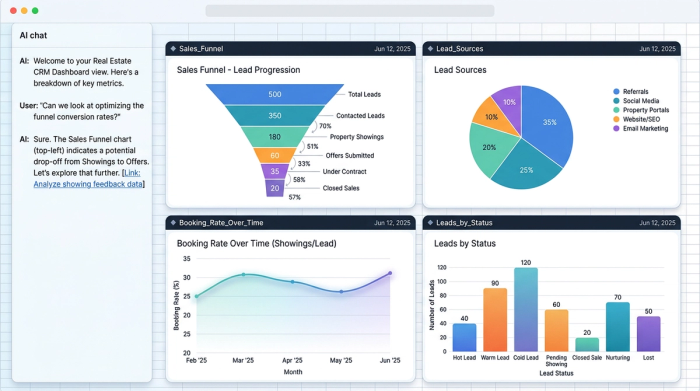
Data is only useful if it helps you make informed decisions. To achieve this, the agency built a visual performance dashboard complete with interactive charts and key metrics. They also included a sales pipeline funnel view to easily track where prospects drop off during the sales cycle. By integrating these visual elements, they transformed a simple real estate lead tracking sheet into a powerful decision-support tool. The team can now spot performance trends and adjust their strategies instantly.
Best practices for real estate lead management
Whether you are an independent agent or running a marketing agency, a few core principles will help you maximize your conversion rates.
Standardize the sales process stages: Define clear and distinct pipeline stages. Categories like contacted, replied, meeting booked, and closed help maintain organization and give your team a unified language for discussing progress.
Obsess over speed to lead: In the real estate industry, response time directly impacts revenue. Implementing sales funnel automation through automated follow-up trackers ensures you reach out to interested prospects while they are still highly engaged.
Track the right metrics: Focus on data that reveals the health of your operation. Monitoring pipeline velocity, conversion rates, and funnel drop-offs will help you identify bottlenecks and refine your outreach strategy.
Ditch the clunky real estate lead tracking excel template
Many professionals start their search by looking for a free real estate lead tracking excel template. While downloading a static file might seem like a quick fix, it is ultimately a short-term solution that will slow you down as your lead volume grows. You do not just need a static template to store names and phone numbers. You need a modern, automated operating system. Quadratic offers a powerful alternative to the traditional real estate lead tracking excel template by combining the familiarity of a spreadsheet with the automation of Python and the visual clarity of a custom dashboard.
Start building your real estate lead tracker in Quadratic
Upgrading your lead management process does not require expensive software or complex implementations. By using a platform built for speed, clarity, and instant insights, you can create a custom solution that fits your exact workflow. Sign up for Quadratic today to build your own Python-powered real estate lead tracker and experience a faster, more automated way to manage your sales pipeline.
Use Quadratic to do real estate lead tracking
- Build a structured, visually intuitive lead database with consistent data entry using dropdowns and color-coded stages.
- Automate daily outreach tracking by pulling real-time performance metrics directly from your lead data, freeing up time from manual updates.
- Power intelligent follow-up automation with native Python, automatically identifying and prioritizing leads that need immediate attention.
- Create dynamic performance dashboards and sales pipeline funnels to instantly visualize progress, spot trends, and make data-driven decisions.
- Replace static spreadsheets and bloated CRM software with a custom, app-like environment that adapts to your unique real estate sales workflow.
Ready to streamline your lead tracking? Try Quadratic.
