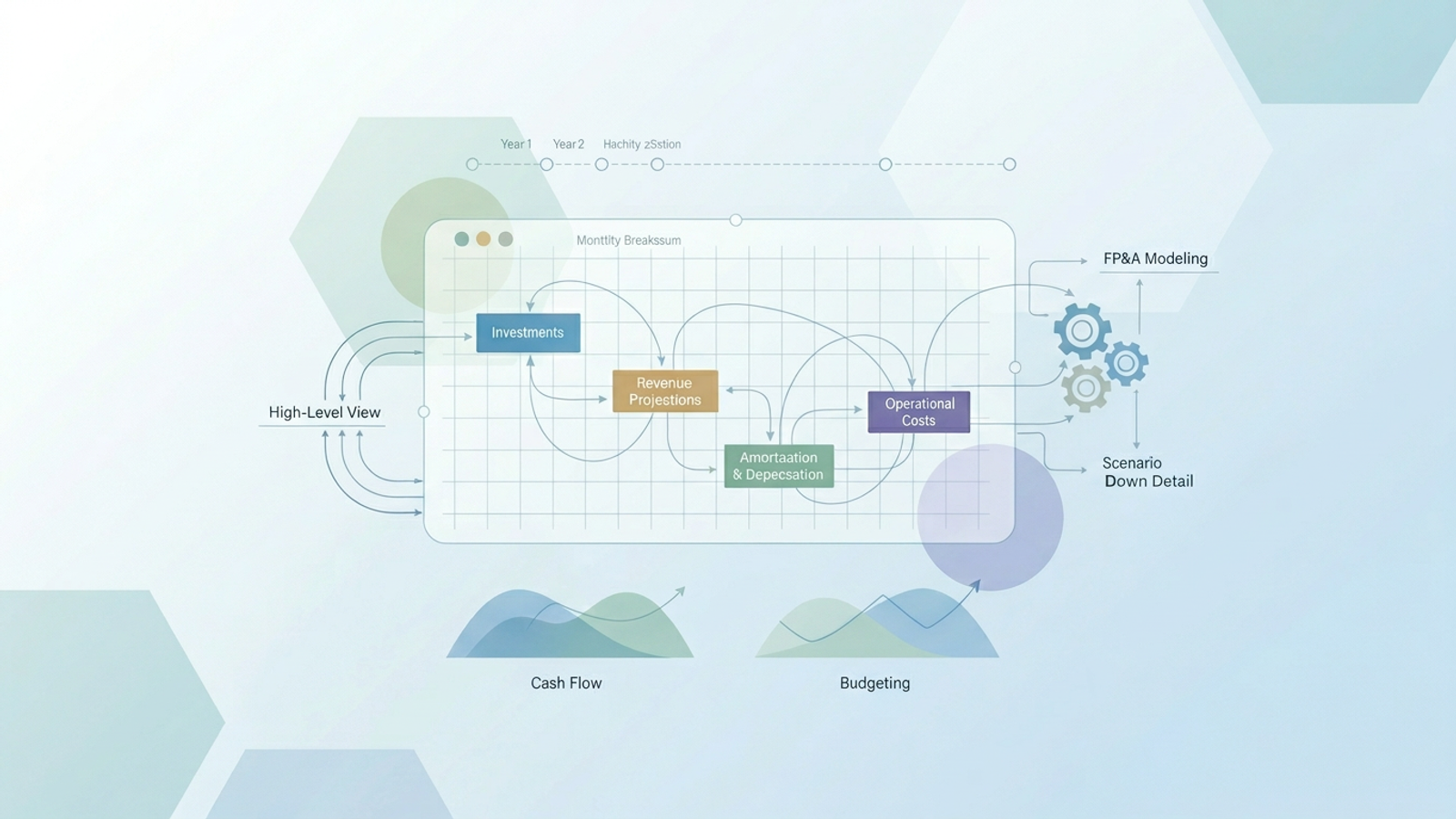
Developing a world-class wellness retreat or medical spa requires immense capital and highly complex financial planning. Before breaking ground, developers and financial planners must map out a detailed lifecycle of investments, operational costs, and projected revenues through robust FP&A modeling to successfully finance a spa.
While many resources discuss the high-level theory of securing funding, very few show exactly how to execute the granular, operational spreadsheet modeling required to prove viability to investors. In this article, we will look at a real-world multi-year resort project and explore how a financial planner successfully modeled its cash flow and operational costs using modern tooling like Quadratic.
Clarifying terms: What is an spa in finance vs. spa financing?
When searching for financial guidance, it is easy to run into overlapping terminology. If you ask a corporate banker what is an spa in finance, they will likely refer to a Sales and Purchase Agreement, which is a legal contract obligating a buyer to buy and a seller to sell a product or service.
However, in the context of commercial real estate and wellness development, real estate financial modeling for spa finance refers to the capital structuring, budgeting, and revenue modeling required to build and operate a wellness facility, resort, or medical clinic. Understanding this distinction is the first step in aligning your financial models with the specific expectations of industry investors.
The complexities of financing for med spas and resorts
Securing financing for med spa projects or large-scale wellness resorts involves rigorous feasibility analysis. Investors expect to see a model that proves financial viability over a multi-year horizon. The wellness industry carries unique variables that make this modeling particularly challenging. These projects require heavy upfront capital expenditures for specialized medical or hydrotherapy equipment, stringent utility requirements, and highly specialized personnel.
Whether you are seeking medical spa financing for a boutique clinic, pursuing med spa financing for a multi-location franchise, or navigating swim spa financing for a luxury property, your financial model must account for these distinct operational realities. A static, easily broken financial forecast template will not suffice when millions of investment dollars are on the line.
Step-by-step: Building a multi-year spa financial model
To successfully finance spa developments, financial planners need to transition from high-level strategy to practical, granular execution. Recently, a financial planning professional used Quadratic to manage a comprehensive operational model for a multi-year wellness resort. By breaking the massive project into distinct, interconnected phases across multiple sheets, the planner ensured both accuracy and readability. Here is how they structured the workflow.
Phase 1: Structuring investments and amortization
The foundation of any major development model is the initial investment schedule, a core component of effective capital budgeting. Specialized equipment and facility build-outs require careful tracking of capital expenditures over time. Using Quadratic, the financial planner mapped out asset depreciation and amortization schedules over a multi-year period.
By dedicating specific sheets to these schedules, the planner kept the capital expenditure data cleanly separated from the monthly operating expenses while still maintaining live, reliable links between them. This structured data presentation allowed project managers to easily track investment phases without getting lost in a sea of unrelated numbers.
Phase 2: Revenue projections and capacity parameters
A common pitfall in wellness resort planning is projecting flat, unrealistic revenue growth. Accurate models must tie revenue directly to actual facility capacity and projected visitor counts. In their Quadratic workspace, the planner built dynamic formulas that calculated income based on changing visitor counts and seasonal capacity parameters.
Because Quadratic features a flexible, browser-based canvas, it was simple to integrate formulas referencing multiple time periods. This meant that if the projected visitor count dropped during an off-peak season, the revenue projections across the entire multi-year timeline updated instantly and accurately.
Phase 3: Operational costs and monthly granularity
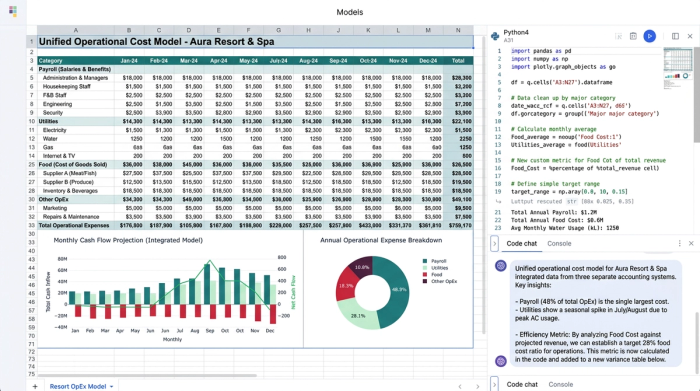
Many financial models fail to secure funding because they do not accurately forecast granular operational costs, a common challenge in building a robust hospitality cash flow model. A wellness resort is incredibly resource-intensive. The planner needed to track highly variable monthly breakdowns, including food costs, specialized personnel expenses, and massive utility bills like heating gas and water.
Quadratic allowed the user to connect these multi-sheet references in a single, unified workspace. Instead of manually updating separate files for utilities and payroll, the planner integrated everything to track exact monthly granularity, ensuring the resort's operational cash flow aligned perfectly with the broader project timelines.
Overcoming spreadsheet clutter: Scenario analysis & financial control
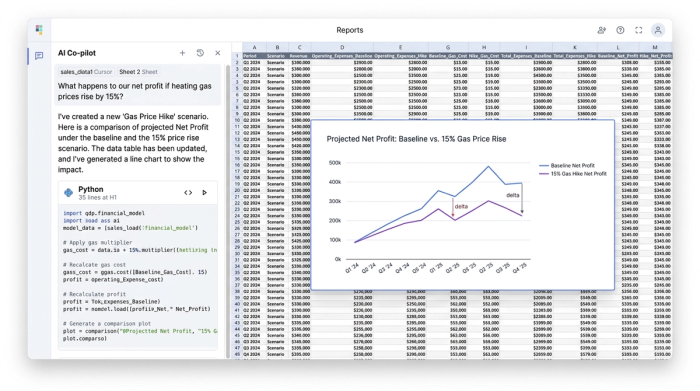
Traditional spreadsheets often become rigid and error-prone when linking multi-sheet data for variance and scenario analysis. This tooling gap makes it difficult to maintain financial control over a complex project. Investors want to see rolling forecasts and a clear sensitivity analysis. They will ask questions like what happens if heating gas prices rise by 15 percent, or what if the visitor count drops by 10 percent.
The financial planner utilized the infinite canvas and visual nature of Quadratic to perform this critical scenario analysis effortlessly. By keeping logic, context, and outputs in one place, the planner could drill down into specific cost or revenue components without ever losing the high-level view. This level of transparency provides ultimate financial control and oversight, allowing project managers and investors to make informed decisions about resource allocation and spa financing without wrestling with broken formulas or hidden cells.
Conclusion: Securing your resort investment
Securing spa financing requires more than just a lucrative business concept. It requires a bulletproof, highly granular, and adaptable startup financial model that can withstand investor scrutiny. By modeling investments, operational expenses, and dynamic revenue capacities with precise monthly granularity, developers can prove the long-term project profitability of their wellness projects. If you are a financial planner or developer tired of rigid, legacy spreadsheets that break under the weight of complex scenario analysis, it is time to upgrade your workflow. Try Quadratic to build your next multi-year resort or medical clinic financial model with the clarity, precision, and ease your project deserves.
Use Quadratic to do spa financing
- Build comprehensive, multi-year financial models for resort and medical spa projects with clarity and precision.
- Structure complex investment schedules, asset depreciation, and amortization across dedicated, live-linked sheets.
- Create dynamic revenue projections that instantly adapt to changing visitor counts and seasonal capacity parameters.
- Track granular operational costs like specialized personnel, utilities, and supplies with exact monthly detail across a unified workspace.
- Perform robust scenario and sensitivity analysis effortlessly on an infinite canvas, maintaining financial control and investor confidence.
Ready to streamline your spa financing models? Try Quadratic.
