Table of contents
- The mechanics of net working capital reconciliation
- Common cash flow errors and compliance roadblocks
- The data workflow gap: why traditional spreadsheets fall short
- Step-by-step: reconciling working capital with Quadratic
- Turning reconciliation into strategic valuation insights
- Use Quadratic to do working capital reconciliation
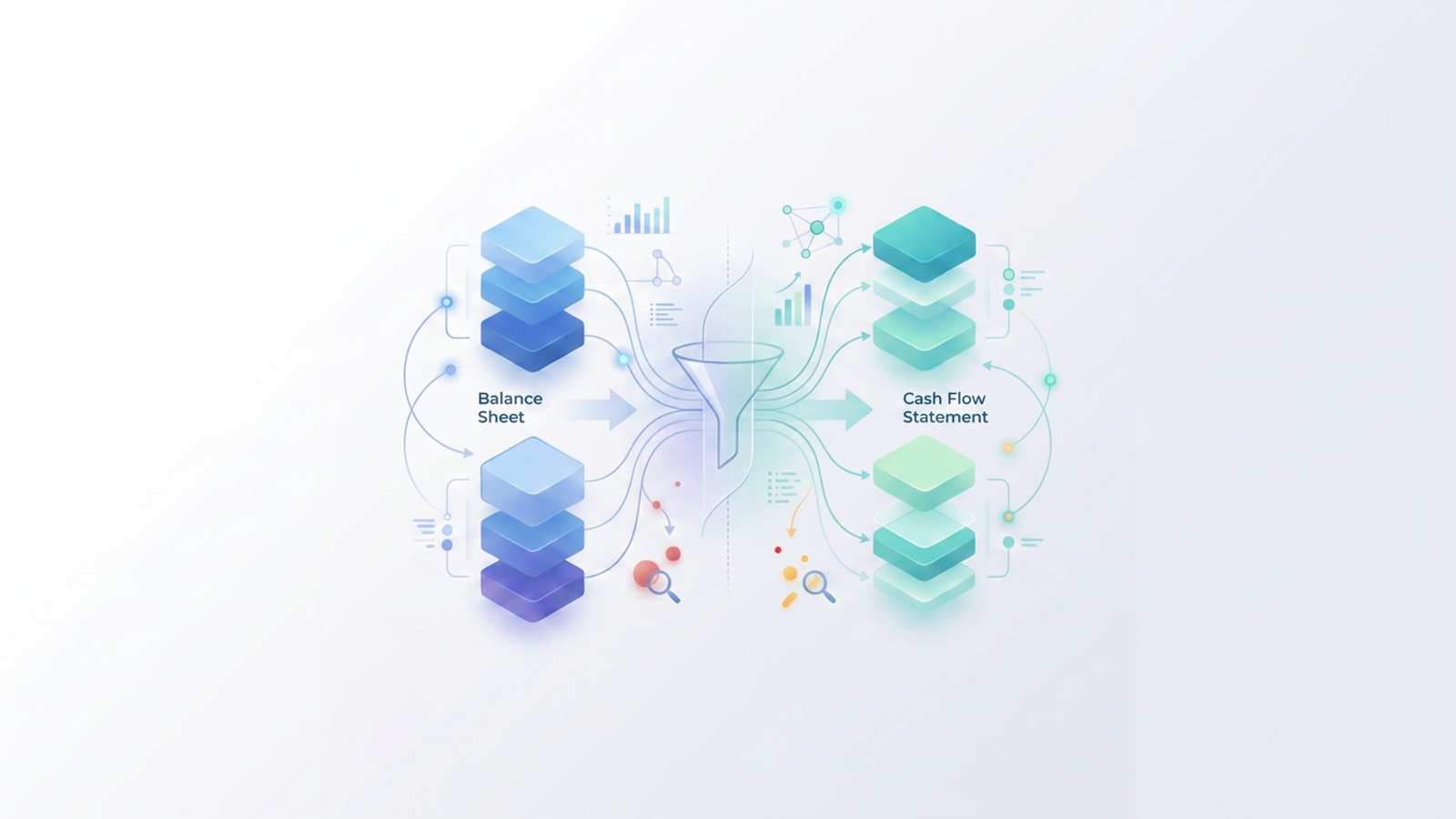
For financial analysts and M&A due diligence professionals, few tasks are as notoriously complex as working capital reconciliation. The fundamental goal is straightforward on paper. You need to ensure that the period-over-period changes in current assets and liabilities accurately reflect actual cash inflows and outflows. When preparing the cash flow statement using the indirect method, this process involves a careful working capital net income reconciliation to adjust for non-cash items and shifts in operating accounts.
However, executing this in a high-stakes environment is rarely simple. During complex financial health assessments or buy-side due diligence, analysts are often handed messy, disparate datasets. Traditional static spreadsheets struggle to handle the depth of investigation required, leaving finance teams searching for a better way to trace cash absorption and resolve discrepancies.
The mechanics of net working capital reconciliation
Before diving into data workflows, it helps to briefly ground the process in the core accounting mechanics. A proper net working capital reconciliation is a cornerstone of any robust 3 statement financial model, bridging the gap between accrual accounting on the balance sheet and actual liquidity on the cash flow statement. The basic formula dictates that an increase in net working capital consumes cash, while a decrease generates cash. This relationship directly impacts the free cash flow calculations used in a discounted cash flow model template, while also influencing vital operational metrics like the Cash Conversion Cycle, Days Sales Outstanding, and Days Inventory Outstanding.
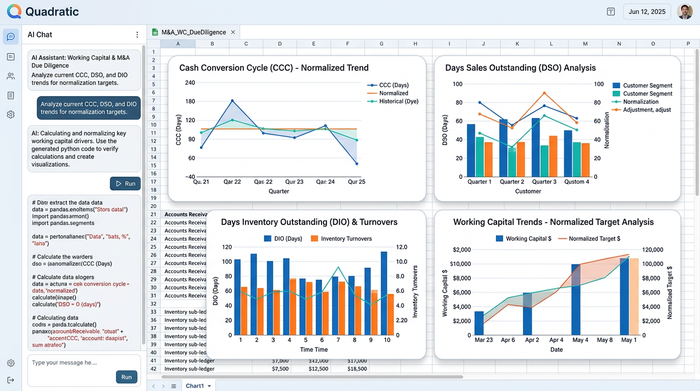
In the context of mergers and acquisitions, these adjustments become critical. Analysts must determine a normalized peg for target working capital, strip out historical anomalies, and identify potential window dressing where a company might artificially inflate short-term liquidity right before a sale. Achieving this requires absolute precision when mapping balance sheet movements to cash flow summaries.
Common cash flow errors and compliance roadblocks
Even with a firm grasp of the theory, analysts frequently run into the dreaded scenario where the schedules simply do not balance. Discrepancies between the balance sheet and cash flow statement often stem from hidden complexities in the underlying data. Common culprits include non-cash transactions that were incorrectly categorized, foreign exchange translation adjustments that skew period-over-period differences, and entirely omitted line items from subsidiary roll-ups.
Compliance standards add another layer of difficulty. Under ASC 606, the treatment of revenue recognition introduces significant challenges regarding contract assets. Defining the exact boundary between a conditional contract asset and a standard unconditional account receivable is highly nuanced. Misclassifying these items can severely distort cash flow analysis, making it difficult to assess true cash generation capabilities during due diligence.
The data workflow gap: why traditional spreadsheets fall short
Knowing exactly what to look for when hunting down ASC 606 misclassifications or hidden foreign exchange impacts is only half the battle. The other half is leveraging modern financial data analytics to uncover these anomalies buried within massive, unstructured datasets.
This is where traditional financial modeling templates begin to break down. Standard spreadsheets are inherently rigid. When an analyst attempts to trace a reclassification across multiple supporting schedules, they are usually met with broken links, circular references, and a manual auditing nightmare. If the raw data exported from an ERP system is too large, legacy spreadsheet applications often lag or crash entirely. Finance professionals need a dynamic, modern data workspace that can handle the reality of messy transactional data without forcing them into hours of manual data entry and cell-by-cell auditing.
Step-by-step: reconciling working capital with Quadratic
To move beyond the limitations of static grids, modern financial analysts are turning to Quadratic to execute complex working capital reconciliation tasks. Quadratic is an AI-powered spreadsheet that combines the familiar grid interface with native Python, SQL, and formulas in a single browser-based canvas. Here is how an analyst handles a rigorous due diligence workflow using this modern approach.
Step 1: Ingesting complex financial data
The process begins by bringing raw financial statements, detailed working capital schedules, and cash flow summaries directly into Quadratic. Because Quadratic connects directly to live databases and handles large datasets seamlessly, the analyst can import millions of rows of transactional data without worrying about the browser crashing. There is no need to aggregate the data externally first.
Step 2: Dynamic balance sheet to cash flow mapping
Once the data is in the grid, the analyst uses Quadratic to automatically calculate the period-over-period changes in current assets and liabilities. Using standard spreadsheet formulas alongside SQL queries, they map these changes directly to the summarized figures on the cash flow statement. Because the environment is dynamic, any adjustments made to the raw data instantly flow through to the reconciliation schedule.
Step 3: Investigating discrepancies
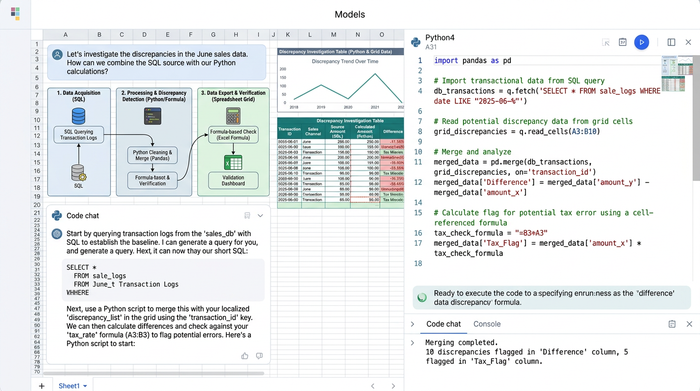
When a schedule fails to balance, the true power of this workflow becomes apparent. Instead of manually tracing broken formula links, the analyst can use SQL or Python right next to their spreadsheet formulas to drill down into the underlying transactional data. If there is a suspected data quality issue or an undocumented reclassification, they can query the exact journal entries causing the gap. This allows them to find the root cause of an unbalanced schedule in minutes rather than days.
Step 4: Deep dive into contract assets
During M&A due diligence, specific accounts require granular attention. The analyst can isolate contract assets to analyze their specific contribution to cash absorption. By using Python scripts within the spreadsheet to parse through complex ASC 606 revenue recognition schedules, they ensure strict compliance and accurately adjust the working capital peg. This level of deep investigation ensures the valuation is based on factual cash dynamics rather than accounting noise.
Turning reconciliation into strategic valuation insights
A modernized workflow transforms a tedious working capital reconciliation from a frustrating accounting exercise into a strategic advantage. By leveraging a tool that handles massive datasets and integrates advanced querying languages natively, financial teams experience faster due diligence, significantly fewer manual errors, and a perfectly clear audit trail.
Accurate working capital reconciliation directly informs broader financial health assessments. It allows teams to improve their fp&a modeling, build reliable cash optimization strategies, and make highly informed final valuation and investment decisions. If you are tired of fighting rigid formulas and crashing workbooks during complex financial modeling, upgrade your workflow. Try Quadratic for your next due diligence or reconciliation project and experience the speed and clarity of a truly modern spreadsheet.
Use Quadratic to do working capital reconciliation
- Connect directly to live databases and ERP systems to pull millions of rows of transactional data into a single browser-based canvas without lagging or crashing.
- Map balance sheet movements to the cash flow statement dynamically using a combination of SQL, Python, and standard spreadsheet formulas in the same grid.
- Investigate unbalanced schedules instantly by querying specific journal entries and tracing discrepancies directly within the sheet.
- Audit complex ASC 606 contract asset classifications and foreign exchange adjustments using built-in Python scripts to ensure strict regulatory compliance.
- Build automated, repeatable templates for M&A due diligence that eliminate manual data entry, circular references, and broken external links.
Simplify your financial due diligence and build highly accurate models without the limitations of traditional spreadsheets. Try Quadratic
