James Amoo, Community Partner
Apr 20, 2026

Table of contents
Measuring employee engagement is a complex challenge, especially when critical data is scattered across pulse surveys, HRIS platforms, and performance review systems. Without a unified view, HR leaders struggle to see the full picture of workforce sentiment and retention risks.
Ultimately, HR analytics employee engagement relies on integrating diverse data sources into a single view. By bridging the gap between raw data and manager-ready summaries, you can empower your frontline leaders with the actionable insights they need to build stronger teams.
This guide serves a dual purpose: helping you evaluate the best people analytics tools for employee engagement, while providing a strategic framework for implementing a repeatable reporting workflow.
The shift toward unified employee engagement analytics
For years, HR teams have relied on siloed systems to measure workforce health. However, isolated data is the biggest roadblock to accurately understanding employee retention and engagement, a common challenge in HR data integration. When exit interviews live in one platform and performance metrics in another, connecting the dots becomes a manual process.
Modern HR strategy requires moving away from static surveys. Instead, organizations need continuous insights that connect qualitative employee feedback with tangible business outcomes and quantitative HR data. By adopting data blending, People Ops teams can identify trends in real time rather than waiting for a yearly review cycle.
Underpinning this entire shift is the need for strict data privacy and confidentiality, a critical concern for HR leaders as highlighted by industry best practices for data privacy. Employee trust must serve as the foundation of any data analytics strategy. When employees know their feedback is anonymized and handled securely, they are more likely to provide the honest insights needed to drive meaningful change.
Key buying criteria for people analytics software
When choosing the best platform for employee engagement analytics, HR leaders must evaluate solutions against several core decision axes. The best data analysis software should simplify your workflow, not add another silo to your tech stack. Keep these employee engagement software criteria in mind during your evaluation:
- Data integration capabilities: A tool must easily pull information from your existing HRIS, survey platforms, and performance management systems. Without seamless integration, your team will waste hours in data exploration and exporting CSV files.
- User-friendliness and accessibility: The insights generated must be easily navigable for non-technical HR staff and the frontline managers who will act on them. Complex tools that require a data science background to operate will ultimately fail to gain internal adoption.
- Scalability and security: As your company grows, your analytics tool must be able to handle larger datasets while reinforcing the need to protect sensitive employee information through robust access controls and compliance standards.
Top people analytics tools by category
The market offers a wide variety of solutions depending on a company's technical maturity and specific reporting needs. Understanding the landscape can help you narrow down the options. Broadly speaking, there are three main categories of tools available to HR and People Ops teams.
Dedicated HR and engagement platforms
Purpose-built platforms like Culture Amp, Lattice, and Glint specialize in running employee surveys and providing out-of-the-box HR metrics. These tools are excellent for teams that want a plug-and-play solution. Their biggest strengths lie in standardized engagement frameworks and built-in manager coaching modules. However, they often have limitations regarding custom integrations. If you need to blend your survey results with external financial data or proprietary company databases, these platforms can sometimes feel restrictive.
General BI and dashboarding tools
Traditional BI tools like Tableau, Power BI, and Looker sit at the opposite end of the spectrum. They offer incredibly powerful visualizations and have the flexibility to connect to almost any data source you can imagine. For enterprise-wide reporting, they are a standard choice. The main drawback is their steep learning curve. These tools typically require dedicated data engineering teams to build and maintain the HR dashboards, which can create a bottleneck for People Ops teams trying to access quick insights.
Next-generation data workspaces
Flexible data workspaces bridge the gap between traditional spreadsheets and heavy BI tools. These platforms allow People Ops teams to blend and analyze data using familiar spreadsheet interfaces, combined with deeper analytical power. This category is the ideal solution for teams that need repeatable reporting workflows and spreadsheet automation without relying entirely on IT. They offer the flexibility to build exactly what you need while keeping the process accessible to analytical HR professionals.
How to build a repeatable engagement reporting workflow
Selecting the right software is only the first step. To truly measure and improve workforce health, you must implement a strategic framework for your analytics process. The ultimate goal is to eliminate manual data pulling entirely in favor of an automated cycle.
1. Connect and integrate your data sources
The foundation of your workflow is bringing your scattered information together. Start by linking your core HRIS roster with anonymized pulse survey results. This allows you to slice engagement scores by department, tenure, or location without compromising individual privacy.
To avoid stale data, utilize live database connections and APIs rather than static file uploads. By connecting directly to your source systems, your reporting environment automatically reflects the latest organizational changes. This prevents discrepancies between different reports and builds leadership trust in the numbers.
2. Design manager-ready summaries
The true value of engagement data is realized when it reaches the end-user: the frontline managers who actually drive team culture. When designing your reports, focus on creating manager-ready summaries rather than overwhelming data dumps, emphasizing data storytelling to turn insights into decisions.
Keep your dashboards clean and focused on actionable metrics. Highlight key areas like team burnout risk and specific drivers of engagement. Structure these reports so managers can easily track their team's progress over time, allowing them to see if their interventions are actively improving the work environment.
3. Automate the reporting cycle
Manual reporting is a drain on HR resources. By scheduling your analyses to run automatically on a weekly or monthly basis, you eliminate the repetitive work of updating spreadsheets.
Automation frees up People Ops teams to focus on higher-value initiatives, such as strategic planning and manager coaching. Furthermore, establishing a predictable reporting cadence ensures that engagement remains a continuous priority rather than a once-a-year discussion.
How Quadratic streamlines employee engagement data analytics
Employee performance management analytics is often fragmented across HRIS platforms, engagement surveys, performance systems, and collaboration tools. This makes it difficult for HR and People Ops teams to form a consistent view of employee engagement. Quadratic provides a unified workspace where these disparate data sources can be combined, analyzed, and visualized into actionable insights. Let’s explore the features of Quadratic in detail.
Direct connections to multiple data sources
Quadratic connects directly to multiple databases, APIs, and raw data. This allows teams to centralize employee data, engagement scores, and operational metrics without manual consolidation.
With all data in one place, HR teams can link engagement results to real workforce indicators such as retention, performance, and compensation. This creates a more holistic understanding of employee experience.
AI-powered data analysis
Quadratic leverages AI agents for data analysis to analyze engagement data and identify key drivers of employee satisfaction or disengagement. This includes surfacing patterns across departments or tenure groups.
AI-assisted analysis reduces the time required to process large HR datasets. Teams can quickly move from raw survey results to meaningful insights that inform strategic decisions. Let’s see how this works.
First, I import my data into Quadratic:
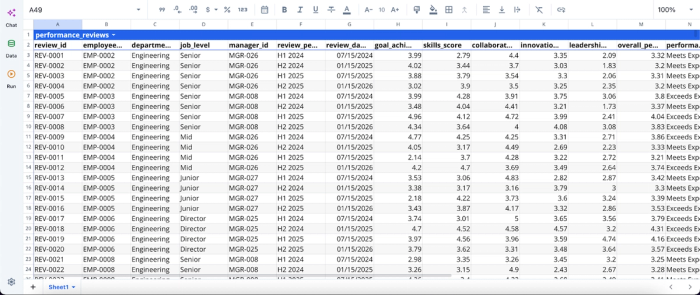
I have successfully imported my sample dataset, which contains properties related to performance review for a company. We can immediately begin to generate insights:
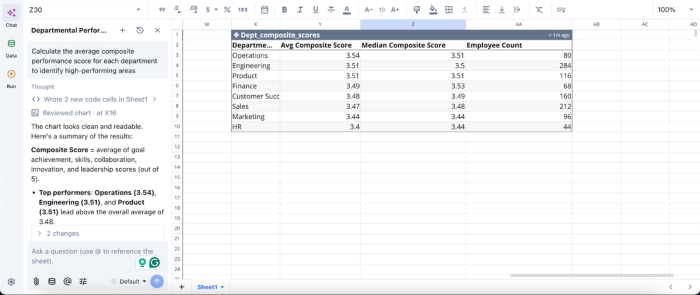
In this image, I ask Quadratic AI to “Calculate the average composite performance score for each department to identify high-performing areas.” It instantly generates a table that gives insights into the average composite score, median composite score, and employee count across all departments in the organization. This allows HR teams to self-serve analytics without waiting for computation from data teams.
AI data visualization
Quadratic enables the creation of interactive dashboards that visualize engagement scores, attrition trends, and workforce composition. These dashboards update automatically as new data is added.
Well-structured visualizations make it easier for leadership teams to interpret complex HR data. This improves communication and supports data-driven decision-making at the executive level. Visualization in Quadratic can also be generated by using simple text prompts. Here:
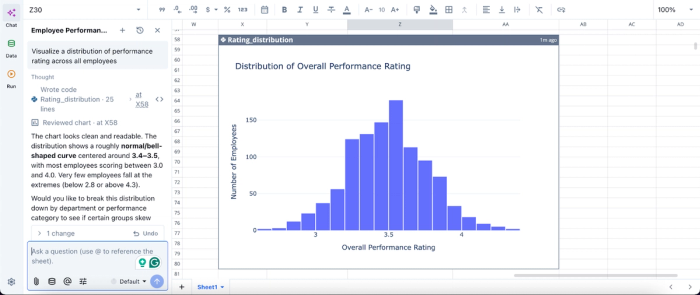
In this image, I ask Quadratic AI to “Visualize a distribution of performance rating across all employees”. In seconds, it creates an interactive chart that displays the distribution of the overall performance rating.
Automated reporting and recurring engagement tracking
Quadratic allows teams to schedule automated data refreshes and reporting workflows. Engagement dashboards and workforce metrics stay up to date without manual intervention.
This automation ensures consistency in reporting cycles, such as monthly or quarterly engagement reviews. Teams can rely on timely insights to guide their actions.
Collaboration between HR, leadership, and analytics teams
Quadratic supports real-time collaboration, enabling HR professionals, analysts, and executives to work together on the same datasets and dashboards. This collaborative analytics platform improves alignment across teams.
Collaboration ensures that insights are validated across stakeholders. It also accelerates decision-making by allowing teams to explore and refine analyses together.
Conclusion
Choosing the best people analytics tools for employee engagement ultimately comes down to your organization’s ability to unify fragmented data and operationalize those insights at the manager level. As engagement measurement evolves from static surveys to continuous workflows, the most effective solutions are those that bridge the gap between raw HR data and real business outcomes.
Quadratic stands out by delivering exactly this balance. Instead of juggling disconnected tools or relying on manual processes, teams can centralize their engagement analytics and move from insight to action faster. If you’re looking to modernize your HR analytics stack and implement a truly data-driven engagement strategy, now is the time to explore what Quadratic can do for your organization. Try Quadratic for free.
Frequently asked questions (FAQs)
Why is unified data crucial for understanding employee engagement?
A unified view of employee data is crucial because scattered information across various systems prevents HR leaders from seeing the full picture of workforce sentiment. Integrating diverse data sources allows for real-time insights into employee engagement.
What key features should HR leaders consider in people analytics tools for employee engagement?
When evaluating people analytics tools for employee engagement, HR leaders should prioritize robust data integration capabilities to connect various HR systems seamlessly. The ideal tool should also be user-friendly for non-technical staff and managers.
How does Quadratic enhance employee engagement analytics and reporting?
Quadratic unifies scattered data by connecting directly to live databases and APIs, integrating HRIS and survey data into a single environment. This flexible workspace allows HR teams to build repeatable engagement reporting workflows using Python, SQL, and formulas, and automate analyses for continuous insights.
