
Table of contents
- Step 1: Building the strategic foundation
- Step 2: Constructing a bulletproof financial model
- Step 3: Advanced scenario testing & risk assessment
- The modern workflow: Bringing your education business plan together in Quadratic
- Conclusion: Presenting your roadmap to stakeholders
- Use Quadratic to build your education business plan
Building a professional education venture requires more than just a great curriculum. It demands a comprehensive education business plan that connects high-level market strategy with rigorous financial modeling. Historically, entrepreneurs have been forced to split this work, often building their strategy in text documents and trying to shoehorn their numbers into a generic financial forecast template that easily breaks when testing new scenarios.
Modern founders are finding a better way. By using a unified, modern workspace like Quadratic, one entrepreneur recently mapped out an entire professional education venture on a single, infinite canvas. This approach brings market research, audience segmentation, and complex financial models together in one highly visual space to present to stakeholders.
Step 1: Building the strategic foundation
Market analysis & target audience segmentation
The first phase of any solid roadmap involves defining exactly who you are serving. For professional education programs, this means detailing the specific industry, career stage, and pain points of your target audience. Organizing your market analysis and competitor insights is crucial here.
When our entrepreneur mapped this out in Quadratic, they used the spatial canvas to visually group competitor pricing data right next to their audience demographics. This visual layout helps investors and stakeholders instantly grasp the Total Addressable Market (TAM) without needing to toggle between a slide deck and a separate document.
Structuring your product, pricing, and curriculum
Once you know your audience, you must define what you are selling and how you will sell it. Your pricing model must directly align with the delivery of your curriculum and your business education lesson plans. For example, a cohort-based program requires a very different sales process and marketing strategy than an ongoing subscription model.
By keeping these product structures in the same workspace as your financial projections, you can instantly see how a change in your curriculum format impacts your marketing budget.
Organizational design & scaling strategy
A successful launch is only the beginning. Stakeholders want to see your hiring roadmap, including timelines for bringing on instructors, sales staff, and administrators.
If your ultimate goal is to scale into an education franchise business plan, your organizational design will need distinct operational templates and localized market strategies. Plotting this scaling strategy on a flexible grid allows you to link future headcount directly to projected enrollment milestones.
Step 2: Constructing a bulletproof financial model
CAPEX, OPEX, and unit economics
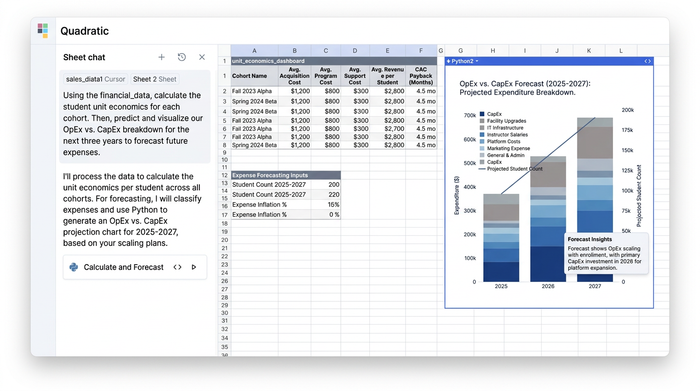
The core of your startup financial model relies on accurate expense forecasting. You need to clearly define your capital expenditures, or CAPEX, which might include your initial tech stack, platform development, or facility costs. Alongside this, you must project your operational expenditures, or OPEX, such as ongoing marketing spend and instructor salaries.
Breaking down your Unit Economics per student is essential to prove the viability of your model. In a modern spreadsheet environment, you can leverage an ai budget generator to explore and clean your data, ensuring your expense estimates are grounded in reality.
Multi-year sales forecasts & P&L statements
Investors expect to see a comprehensive 3 statement financial model, including multi-year sales forecasts, Profit and Loss (P&L) statements, and cash flow projections. In traditional legacy spreadsheets, founders often hide these crucial elements across dozens of isolated tabs. This makes the model difficult to navigate and incredibly fragile.
When plotting out cash flow, our entrepreneur used Quadratic's infinite canvas to place the P&L directly next to the marketing budget. Organizing these as distinct, easily navigable sections on a single screen creates a clear, unbroken line between your strategic inputs and your financial outcomes.
Step 3: Advanced scenario testing & risk assessment
Break-even analysis
Every stakeholder wants to know exactly when the venture will become profitable. Calculating your break-even point involves analyzing your fixed costs, variable costs, and projected revenue per student. Presenting this figure clearly builds confidence and shows that you understand the financial realities of your launch timeline.
Multi-scenario financial modeling (without the macros)
A static financial model is rarely enough, especially when modern best practices demand robust scenario planning to test multiple assumptions. Investors expect to see a best case, a worst case, and an expected scenario. In the past, running multi-variable stress tests meant relying on complex Excel macros, nested data tables, or frustrating circularity workarounds. This is where traditional tools often fail founders.
Instead of wrestling with macro-heavy spreadsheets, you can use Quadratic to streamline your fp&a modeling and run multi-scenario projections seamlessly. Because it supports native Python, SQL, and formulas in the same browser-based canvas, you can adjust a single variable, like student acquisition cost, and watch the entire model update instantly without fear of breaking a fragile chain of formulas.
The modern workflow: Bringing your education business plan together in Quadratic
Building a comprehensive roadmap requires integrating product structures, competitor insights, and multi-year financials into one cohesive view. Our entrepreneur achieved this by treating their spreadsheet as a dynamic presentation layer.
They utilized Quadratic's native visual aids and spatial layout to draw clear lines between the marketing strategy and the resulting cash flow. Presenting a unified, visual, and mathematically sound roadmap builds far more investor confidence than toggling between a traditional slide deck and a separate, disconnected Excel file. The logic, context, and outputs all live in one place.
Conclusion: Presenting your roadmap to stakeholders
A winning education business plan must be both strategically sound and financially rigorous. By connecting your high-level market research directly to your detailed revenue projections, you show stakeholders that your venture is built on a solid, adaptable foundation.
It is time for business strategists and founders to ditch the constraints of clunky legacy spreadsheets. Try Quadratic today to build your multi-scenario financial models and strategic roadmaps in a single, powerful workspace designed for modern data analysis.
Use Quadratic to build your education business plan
- Map your target market, competitor pricing, and curriculum structures next to your financial projections on a single, infinite canvas.
- Connect future headcount, like instructors and administrators, directly to projected student enrollment milestones.
- Build complete multi-year sales forecasts and P&L statements alongside your marketing budget to show stakeholders the unbroken link between strategy and cash flow.
- Run complex scenario planning and break-even analyses using native Python and SQL without wrestling with fragile Excel macros.
Ready to map out your strategy and financial model in a single, collaborative workspace? Try Quadratic
