
Table of contents
- The challenge of disconnected retail industry financial analysis
- Step 1: Extracting and synthesizing retail financial metrics
- Step 2: EBITDA projections and financial forecasting in retail
- Step 3: Bond valuation and debt refinancing modeling
- Step 4: Translating the model into a corporate pitch
- Conclusion: A modern approach to financial planning in retail
- Use Quadratic to do retail financial planning
Corporate retail financial planning requires synthesizing massive amounts of data and adhering to financial modeling best practices. From granular store-level metrics to macro-level corporate debt structuring, the process is notoriously complex. Traditionally, financial analysts and corporate finance students are forced to rely on siloed spreadsheet templates, rather than an integrated financial forecast template. You might use one sheet for historical key performance indicators, another for EBITDA forecasting, and a completely separate model for bond valuation methodology. This fragmentation makes financial management in retail a frustrating exercise in manual reconciliation.
Enter Quadratic, a modern spreadsheet environment designed for integrated financial modeling. In this article, we will walk through a real-world workflow of analyzing a major retail corporation. We will explore how to extract raw data, project growth, and model a corporate debt refinancing scenario, all within one cohesive workspace.
The challenge of disconnected retail industry financial analysis
When conducting retail industry financial analysis, analysts are expected to pull critical information from income statements, balance sheets, and cash flow statements to assess corporate health through financial statement analysis accurately. However, the friction in traditional tools quickly becomes apparent. Moving data from raw financial statements into actionable forecast models often results in broken links, version control issues, and cumbersome manual updates.
To build a robust financial pitch, such as assessing financial strengths and concerns alongside corporate bond ratings, you need a unified system. Data must flow seamlessly from historical extraction to predictive valuation without the constant risk of human error.
Step 1: Extracting and synthesizing retail financial metrics
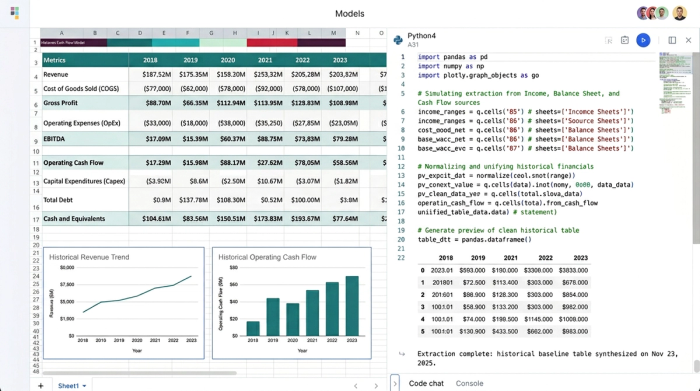
The first phase of any comprehensive evaluation involves establishing a reliable baseline of historical performance. Using Quadratic, a user can import and structure detailed financial data across multiple sheets, keeping the income statement, balance sheet, and cash flow statement organized within a single browser-based canvas.
For a major big-box corporation, tracking specific key retail financial metrics is essential. In this workflow, the analyst extracts membership fee revenue versus total revenue, which is a highly relevant indicator of customer loyalty and recurring income. They also isolate gross margin and operating expenses to evaluate core profitability. From there, the focus shifts to income from operations, operating cash flow, and capital expenditures. Finally, to prepare for the upcoming debt analysis, total interest-bearing debt and total equity are pulled into the summary. Quadratic's flexible grid allows for the precise extraction and dynamic synthesis of these metrics without the typical spreadsheet clutter. This creates a clean, reliable baseline for the rest of the financial assessment.
Step 2: EBITDA projections and financial forecasting in retail
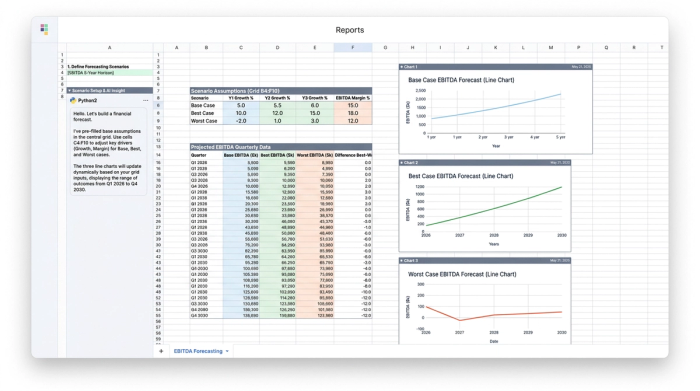
With historical data securely structured, the analysis transitions from looking at the past to predictive modeling. The next step is calculating baseline EBITDA from the extracted data and setting up a model for robust financial forecasts.
The mechanics of financial forecasting retail involve building out EBITDA growth projections under different compounding scenarios. An analyst typically needs to evaluate a base case, a best case, and a worst case to understand the full range of potential outcomes. Quadratic handles this multi-scenario modeling cleanly. Because the platform integrates formulas, Python, and SQL in the same workspace, users can instantly see how changes in growth assumptions impact the overall corporate valuation. Adjusting a single revenue assumption automatically cascades through the connected models, eliminating the need to update multiple isolated files manually.
Step 3: Bond valuation and debt refinancing modeling
Once the EBITDA forecast is established, it is time to connect those projections to the company's capital structure and debt capacity. The core of this phase involves building a bond valuation table directly linked to the previously established financial metrics and corporate bond ratings.
In a traditional setup, analysts might learn to use a simple price function in isolation. Quadratic elevates this process by allowing the bond valuation table to update dynamically as underlying retail EBITDA assumptions change. The user models a planned refinancing of the entity's long-term debt by calculating issue proceeds under various yield scenarios. If the base case EBITDA projection shifts, the debt capacity and subsequent bond pricing reflect that change immediately. This interconnected approach ensures that the valuation is always grounded in the most current operational forecasts.
Step 4: Translating the model into a corporate pitch
The ultimate goal of this workflow extends beyond simply filling out a spreadsheet. The analysis is designed to support a comprehensive financial strengths and concerns assessment for a final PowerPoint pitch.
Having a fully integrated model in Quadratic ensures that the analyst is always prepared for sudden adjustments. When a managing director or a corporate finance professor asks for a change in yield assumptions or growth rates, the entire retail store financial plan and bond valuation update instantly and accurately. All logic, context, and outputs remain in one place. This seamless flow from raw data to final presentation empowers users to confidently defend their valuation methodologies and debt structuring recommendations.
Conclusion: A modern approach to financial planning in retail
An integrated approach to retail financial planning transforms a fragmented, error-prone task into a streamlined and strategic workflow. Extracting financial data, forecasting EBITDA, and pricing corporate bonds should not happen in isolated silos. By bringing these elements together, analysts can focus on generating insights rather than hunting down broken spreadsheet links.
Modern financial planning in retail requires speed, clarity, and precision. Quadratic provides the ideal environment to connect historical metrics with complex predictive models seamlessly. Whether you are preparing a corporate finance coursework assignment, building a debt refinancing model, or finalizing a crucial pitch, trying Quadratic can help you move from raw data to a finished presentation faster and more reliably.
Use Quadratic to do retail financial planning
- Integrate complex models: Synthesize massive retail data, from store-level metrics to corporate debt structuring, within one cohesive workspace.
- Streamline data flow: Move data seamlessly from historical financial statements into robust forecast models, eliminating broken links and manual reconciliation.
- Conduct dynamic analysis: Extract and synthesize key retail financial metrics across multiple sheets, creating a clean, reliable baseline for all assessments.
- Perform multi-scenario forecasting: Build and instantly adjust EBITDA growth projections under various scenarios, seeing real-time impacts on corporate valuation.
- Automate bond valuation: Link bond valuation tables directly to your financial metrics and corporate bond ratings, ensuring dynamic updates as underlying assumptions change.
- Prepare agile pitches: Make instant adjustments to your retail financial plan and debt valuation, ensuring accuracy for corporate pitches and financial presentations.
Ready to build more integrated and dynamic financial models? Try Quadratic.
