
James Amoo, Community Partner
Apr 30, 2026

Startups operate on a ticking clock. To find product-market fit and drive sustainable growth, teams need rapid insights, not raw data dumps that take weeks to decipher. For resource-constrained founders and product managers, the core challenge is finding a solution that offers speed to build a solid data infrastructure and analytics strategy without requiring a massive engineering lift. Evaluating the best product analytics tools for startups is about choosing a foundation that provides clear visibility into the data analytics lifecycle.
This guide explores how to select the top product analytics solutions for startups and build agile workflows that turn everyday user behavior into highly actionable insights.
Web analytics vs. product analytics: What startups need to know
Many early-stage teams mistakenly rely on traditional web analytics to measure their product's success. While web analytics tools are great for conversion tracking and acquisition channels, they fall short when it comes to measuring actual product usage analytics for startups.
Product analytics tools focus on what happens after a user signs up. It tracks specific actions and deep engagement inside the actual application. For a startup to survive and scale, the focus must inevitably shift from top-of-funnel traffic to user activation, feature adoption, and monetization. Choosing the right tool begins with recognizing this fundamental difference in data tracking and business objectives.
Another key distinction lies in how each approach structures data. Web analytics typically organizes information around sessions and page loads, which works well for understanding navigation patterns but becomes limiting when you need to analyze complex user journeys. Product analytics, on the other hand, is built around event-based tracking, where every meaningful user interaction is recorded as a distinct event. This allows for much more granular insight into how users actually derive value from the product.
The difference in structure also impacts decision-making speed and accuracy. With product analytics, teams can directly connect user behavior to outcomes like retention or revenue, making it easier to identify which features drive growth and which create friction. This leads to faster iteration cycles and more focused product improvements.
Key evaluation criteria for startup product analytics
When evaluating the best product analytics platform for startups, resource constraints should heavily influence your decision. A tool is only valuable if your team can actually use it to answer questions quickly and consistently. In early-stage environments, speed of insight often matters more than depth of features, because decisions need to be made with limited data and evolving product direction.
Implementation speed is one of the most important factors to assess. Platforms that offer low-code or no-code setup reduce dependency on engineering resources, allowing product managers and growth teams to instrument events and generate reports independently. This accelerates experimentation cycles and prevents analytics from becoming a bottleneck every time a new tracking requirement emerges.
Clear lifecycle visibility is equally critical when choosing a platform. The ability to trace a user’s journey from acquisition through activation, cohort analysis, and into long-term retention helps teams understand where value is created or lost. Without this, it becomes difficult to connect product changes to real business outcomes.
Finally, teams must carefully consider the trade-offs between flexibility and all-in-one suites. Large enterprise platforms often bundle many features, but they can introduce unnecessary complexity and slower workflows. In contrast, specialized tools that integrate smoothly into a broader data stack tend to offer greater agility.
The rigidity trap of traditional analytics dashboards
While native product analytics platforms are powerful, relying entirely on their built-in dashboards can create bottlenecks. These dashboards are excellent for tracking standardized metrics, but they often lack the agility required for custom iteration.
As a startup scales, a new challenge emerges: siloed data. Eventually, you need to combine your product behavior data with broader CRM, revenue, and operational datasets to get a complete picture of your business. Attempting to solve this by exporting data from your analytics platform into traditional spreadsheets like Excel and Google Sheets usually results in stale data.
One additional limitation of native dashboards is their constraint around exploratory data analysis. Most product analytics tools are optimized for predefined questions, which means they work best when you already know what you want to measure. However, startups often operate in an environment where questions evolve quickly. In these cases, rigid dashboard structures can slow down discovery and force teams to rely on incomplete or overly simplified views of user behavior.
Another issue is the gap between insight and action. Even when dashboards surface useful trends, translating those insights into deeper analysis or operational decisions often requires data transformation or involves engineering support. This creates friction between identifying a problem and investigating it fully. Teams that can work directly with their raw data in a flexible environment reduce this gap significantly.
How Quadratic streamlines product analytics
Startups often struggle with product analytics, not because of a lack of tools, but because of fragmentation across them. Event tracking lives in one platform, revenue data in another, and experimentation results somewhere else entirely. The best product analytics tools for small tech startups allow you to access these metrics from a single dashboard. Quadratic addresses this gap by turning product analytics into a unified workspace where all growth and market data can be analyzed together in real time. Let’s explore these features in detail:
Direct connections to multiple product data sources
Quadratic integrates directly with tools like product analytics platforms, CRM systems, and billing infrastructure, allowing startups to pull live datasets into a single environment. This removes the dependency on static CSV exports or brittle ETL pipelines.
By centralizing these sources, teams can immediately connect user behavior metrics with monetization data. This makes it possible to understand not just what users are doing, but how those actions translate into revenue.
AI-powered data analysis for growth insights
Quadratic uses AI to help teams explore product data without requiring complex manual queries or rigid dashboard configurations. You can generate retention cohorts, funnel analyses, and behavioral segments directly within the workspace.
This allows startups to iterate on growth hypotheses much faster. Instead of waiting for engineering support or building new dashboards, teams can quickly test ideas and refine their understanding of user behavior. Let’s see how this works:
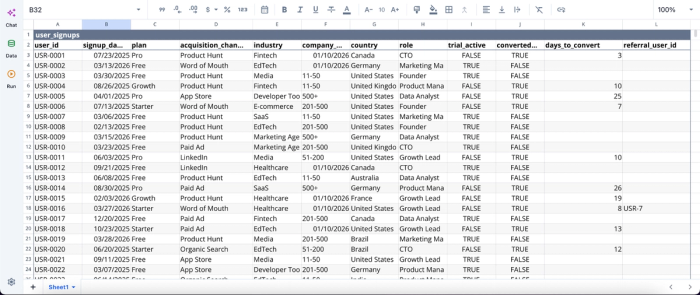
Here, I have a 1000-row dataset of user sign-up data, containing metrics such as user ID, acquisition channel, and trial status. Manually scanning through 1000 rows of data to get a particular insight can take hours or even days. With Quadratic, all you have to do is ask using simple text prompts, and you get your result in seconds. Here:
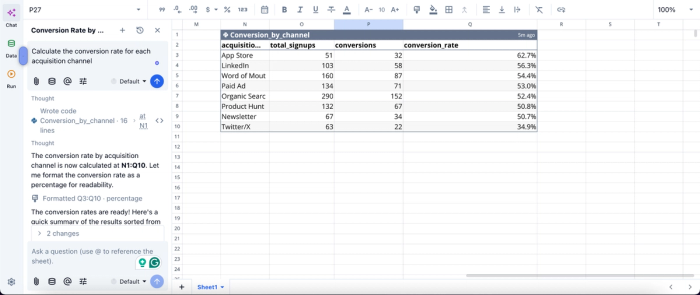
In this image, I ask Quadratic AI to “Calculate the conversion rate for each acquisition channel”. It creates a table that shows the total signups for each acquisition channel, the total number of conversions, and the conversion rate. With Quadratic, users do not need technical expertise in coding or complex formulas to generate insights from their data.
AI data visualization for rapid experimentation
Quadratic also functions as a data visualization software that streamlines dynamic visualization of product metrics, allowing teams to instantly chart funnels and feature adoption trends. These visuals are directly linked to the underlying data, ensuring consistency between analysis and presentation.
This tight coupling makes experimentation more intuitive. Product managers can immediately see the impact of changes and validate whether product iterations are driving meaningful improvements. Visualization in Quadratic can also be done using text prompts. Here:
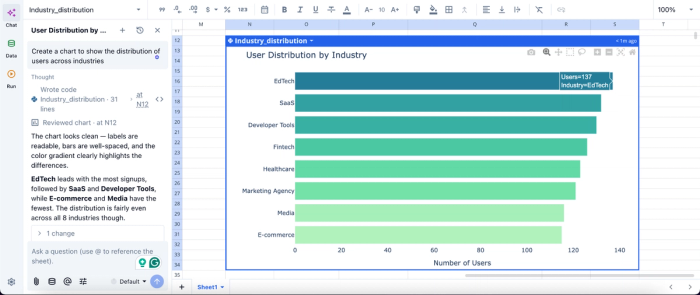
In this image, I ask Quadratic AI, “Create a chart to show the distribution of users across industries”. In seconds, it generates an interactive chart that shows the user distribution by industry. This helps to streamline the communication of insights to non-technical stakeholders.
Unified event and revenue analysis
Quadratic allows startups to combine behavioral event data with revenue and billing information in a single model. This makes it possible to directly connect product usage patterns with monetization outcomes.
This approach helps teams understand which features drive revenue and which behaviors correlate with long-term retention.
Collaboration
Quadratic supports simultaneous collaboration, allowing product managers, analysts, and engineers to work together on the same datasets and models. This eliminates version mismatches and improves alignment on key metrics.
Since everyone operates in a collaborative analytics platform, definitions such as “active user” or “conversion event” remain consistent across teams.
Conclusion
Building a data-driven growth engine starts with choosing the right foundational tracking tool and pairing it with a unified analysis environment. By moving beyond basic web metrics and focusing on deep user behavior, your team can uncover the insights needed to scale.
Startups should focus heavily on iterating their activation and retention strategies based on combined data sources. Remember that the best product analytics tools for startups are the ones that provide immediate clarity today while remaining flexible enough to scale with your startup's evolving questions tomorrow.
Quadratic allows you to connect directly with platforms like Mixpanel and Amplitude to build an activation and retention dashboard that’s easy to iterate on. Try Quadratic for free.
Frequently asked questions (FAQs)
What are the best product analytics tools for startups?
The top product analytics tools for startups are those that provide rapid insights into user behavior with minimal engineering overhead. Platforms like Mixpanel, Amplitude, and PostHog are widely recognized for their core strengths in event tracking, funnel visualization, and cohort analysis. The prioritizes implementation speed and flexibility to meet immediate reporting needs.
Why is it important for startups to combine product data with other business metrics?
Relying solely on native product analytics dashboards can lead to data silos and limit the ability to answer complex business questions. To gain a complete picture of growth and iterate effectively, startups need to combine product behavior data with broader CRM, revenue, and operational datasets.
How does Quadratic help startups analyze product data more effectively?
Quadratic enhances a startup's product analytics by providing a flexible, AI-powered spreadsheet environment that integrates directly with tools like Mixpanel to pull live product behavior data. This allows teams to combine product data with revenue and other business metrics using native Python, SQL, and formulas in one canvas.
