James Amoo, Community Partner
Mar 3, 2026

It is a common scenario in modern growth teams: marketing hits its lead volume targets, yet the company misses its quarterly revenue goals. This often leads to finger-pointing, with the sales team complaining about lead quality and the marketing team insisting they met their KPIs. The root cause is rarely a lack of effort but rather a lack of systemic connection.
Full-funnel marketing is often misunderstood as simply "doing more marketing" or running ads at every stage of the buyer’s journey. In reality, a true full-funnel marketing strategy is an operational framework. It connects disjointed stages of the customer data analysis into a single, cohesive revenue system.
Organizational friction naturally occurs when marketing owns the lead, sales owns the deal, and product owns the user experience, but no single entity owns the entire data picture. To solve this, teams must align on clear ownership, supported by compelling sales and marketing alignment statistics, and establish a data feedback loop that prioritizes revenue quality over simple lead volume.
In this blog post, we’ll explore how to build a full funnel marketing workflow, ensuring all teams stay aligned on the picture that matters.
What is full funnel marketing?
Full-funnel marketing is a holistic approach that tailors messaging, data analysis, KPIs, and business data analysis. Unlike traditional methods that treat the funnel as a series of isolated buckets, this approach recognizes that the customer journey is continuous and interconnected.
The traditional linear funnel failed because it relied on a "relay race" mentality. Marketing teams would run the first leg and pass the baton (the lead) to sales teams, often stopping their analysis at that hand-off. Once the lead was in the CRM, marketing visibility vanished.
However, the modern buyer journey is often a complex and non-linear path. Prospects loop back and forth between research, consideration, and trial. A full-funnel digital marketing strategy captures intent at every unpredictable touchpoint. It shifts the organization’s focus from merely generating leads to generating revenue, making the team accountable for Lifetime Value (LTV) rather than just optimizing for the lowest possible Customer Acquisition Cost (CAC).
Full-funnel marketing strategy: defining goals and ownership
A full-funnel system only works when every stage has a clearly defined purpose and a clearly accountable team. Many organizations attempt full-funnel marketing by layering new campaigns on top of existing ones without redefining responsibility or success metrics. Each stage must have a measurable outcome, a primary owner, and shared supporting stakeholders who understand how their work connects to downstream results. Let’s explore this in detail:
Acquisition (Awareness and consideration)
The acquisition stage is often misunderstood as a traffic-generation or conversion tracking exercise, but traffic alone rarely translates into revenue. The real goal is attracting qualified demand, which means people who resemble successful customers and are likely to progress further into the product experience. Marketing typically owns this stage because it involves channel strategy, messaging, positioning, and audience targeting across paid, organic, and partnership channels.
However, qualification cannot be defined in isolation. Metrics like impressions, clicks, or even sign-ups can become misleading if they are disconnected from later performance. High click-through rates mean little if those users never activate or convert into paying customers.
Effective acquisition teams rely heavily on downstream data, using product analytics tools and revenue outcomes to refine targeting and messaging. Acquisition succeeds when marketing optimizes not just for attention, but for future value.
Activation (Conversion and onboarding)
Activation sits at the intersection of marketing and product, which makes ownership shared by necessity. Generating a sign-up is only the beginning; the real objective is guiding users toward experiencing meaningful value as quickly as possible, often referred to as the “aha” moment. This is the point where a user understands why the product matters to them personally.
Product teams primarily influence activation through onboarding flows, UX design, feature discoverability, and performance reliability. Marketing, meanwhile, reinforces these efforts outside the product through onboarding emails, educational content, retargeting campaigns, and lifecycle messaging. When these efforts operate independently, users receive fragmented guidance. When data blending is adopted, they create a continuous experience that moves users smoothly from curiosity to engagement.
Successful activation strategies focus on product management metrics that reduce friction and shorten time-to-value. That might involve simplifying account setup, highlighting key features based on user intent, or using behavioral triggers to deliver timely education. Measuring activation also requires clarity: teams must agree on what constitutes meaningful usage. Whether it is completing a project or reaching a usage threshold, defining activation precisely allows both marketing and product to optimize toward the same outcome.
Retention (Expansion and advocacy)
Retention is where long-term growth compounds. Acquiring new customers is expensive, and without strong retention, acquisition efforts become increasingly inefficient. This stage is typically owned by customer success and product because it depends on delivering ongoing value, supporting users effectively, and evolving the product to meet changing needs.
Rather than viewing retention as passive renewal management, a full-funnel approach treats it as an active growth engine. Communication continues well beyond the initial purchase through education, feature announcements, and targeted lifecycle campaigns. Marketing often re-enters the funnel here through customer storytelling and advocacy initiatives that transform satisfied users into acquisition channels themselves.
Metrics such as Net Dollar Retention (NDR), expansion revenue, and churn provide a clearer picture of product health than raw customer counts. High retention signals strong product-market fit and allows organizations to invest more confidently in acquisition.
The data challenge: why silos kill strategy
Even when teams agree on goals and funnel ownership, execution often breaks down at the data layer. Modern companies generate enormous amounts of operational data, but it is fragmented across specialized systems designed for individual functions rather than shared decision-making.
Advertising platforms optimize campaigns, CRMs manage relationships, billing tools track revenue, and product analytics measure engagement, each solving a narrow problem extremely well. The difficulty arises when leadership tries to answer cross-functional questions such as “Which campaign produced our highest-retention customers?” or “What onboarding behavior predicts expansion revenue?” Without unified visibility, those questions become slow investigations instead of routine insights.
Another challenge is data inconsistency across systems. The same customer may appear under different identifiers depending on the platform: an email address in marketing automation, an account ID in the CRM, and a user ID inside the product database. Without careful identity resolution, teams unintentionally compare unrelated records or double-count performance. Time delays compound the problem. Advertising platforms update performance metrics in near real time, while billing or warehouse data may sync daily or weekly, creating mismatched reporting windows that distort performance analysis.
Metric fragmentation also poses a major concern. Each department tends to optimize for metrics native to its tools rather than metrics tied to company outcomes. Marketing visualizations prioritize cost per click or cost per lead, sales visualizations focus on pipeline velocity, and product analytics visualizations emphasize feature engagement.
Individually, these metrics are useful; collectively, they can produce conflicting narratives about performance. A campaign might appear successful from a lead-generation standpoint while quietly generating low-value customers who churn quickly. Without joined datasets and an adequate funnel analysis, organizations struggle to detect these misalignments early.
How Quadratic unifies your full-funnel analysis
The solution to the data silo problem is a central hub that allows for flexible and transparent analysis. Quadratic functions as one of the best marketing funnel analytics tools, connecting ad platforms, CRMs, and product data directly within a single interface.
Direct connection to multiple sources
Full-funnel analysis begins with connectivity. Without reliable ingestion pipelines, teams inevitably fall back on manual CSV data analysis and stitched spreadsheets that quickly become outdated. Quadratic allows teams to connect directly to databases, APIs, and raw data, allowing you to turn your spreadsheet into a live data environment rather than a static reporting tool.
This also enables marketing teams to seamlessly connect campaign costs directly to onboarding behavior, compare acquisition channels against retention outcomes, or measure the relationship between feature adoption and expansion revenue.
AI for data analysis and visualization
As marketing datasets grow, analysis becomes less about gathering information and more about interpreting it quickly. Quadratic integrates AI capabilities directly into the spreadsheet, helping teams explore patterns and summarize trends without extensive manual setup.
AI can assist with identifying anomalies in acquisition performance, suggesting cohort analysis worth investigating, or generating explanations for unexpected changes in retention or conversion rates. Instead of manually combing through rows of campaign data, teams can focus on strategic interpretation of their raw data. Let’s see how this works.
First, I import my marketing data into Quadratic:
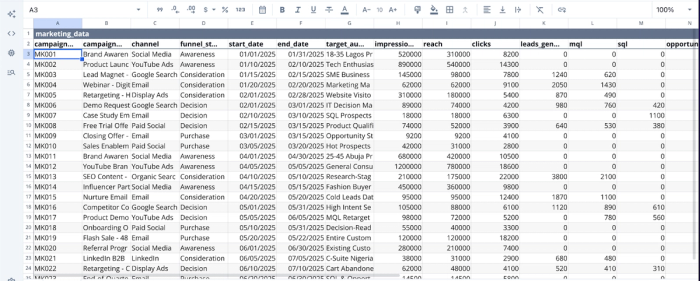
After successfully importing (or connecting to) your data in Quadratic, you can immediately begin analysis. Suppose I want to get insights into how emails and paid social campaigns perform at the decision stage:
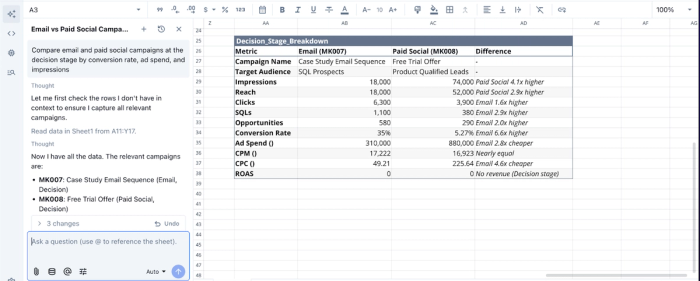
I prompt Quadratic AI, “Compare email and paid social campaigns at the decision stage by conversion rate, ad spend, and impressions”, and it instantly generates a table to show how they compare. It doesn’t end there; it also generates an interactive visualization based on that request. Here:
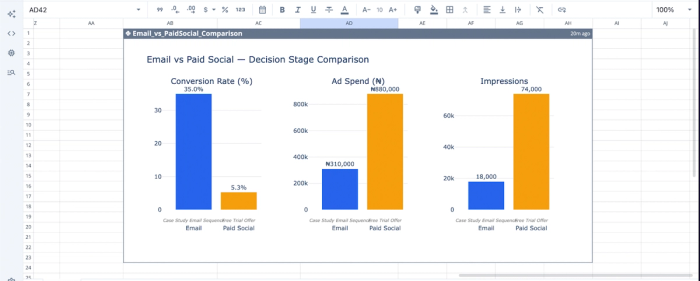
Thanks to Quadratic’s built-in data visualization capabilities, users can get insights into their marketing data at a glance.
Real-time collaboration
Even the best analysis fails when teams operate from separate versions of reality. Marketing may believe a campaign succeeded based on lead volume, while product teams see poor activation, and customer success observes increased churn months later. Fragmented reporting environments make these disagreements inevitable.
Being a collaborative analytics platform, Quadratic reduces this friction by allowing multiple stakeholders to operate from the same datasets in real-time. Marketing leaders can review campaign performance alongside sales pipeline outcomes, while product managers can examine onboarding behavior without waiting for exported reports.
Conclusion
Full-funnel marketing represents a fundamental shift from generating leads to generating revenue. It requires breaking down the walls between departments and looking at the customer journey as a single and continuous narrative.
The competitive advantage in this approach lies in the speed of your feedback loop. The faster you can learn from customer retention data to improve your acquisition strategy, the more efficient your growth will become.
Quadratic allows you to seamlessly connect your marketing, CRM, and product data in one environment, empowering you to build a full-funnel dashboard that tracks what actually drives activation, conversion, and retention. Try Quadratic for free.
Frequently asked questions (FAQs)
What is full funnel marketing?
Full funnel marketing is a holistic operational framework that connects all customer lifecycle stages into a single, cohesive revenue system. It tailors messaging, data analysis, and KPIs across the entire customer journey, shifting focus from lead generation to revenue generation.
Why is a full funnel marketing strategy essential for revenue growth?
A full funnel marketing strategy is crucial because the traditional linear funnel often creates disconnects between marketing and sales, leading to missed revenue goals despite hitting lead targets. This approach ensures accountability for Lifetime Value (LTV) by analyzing the entire customer journey, not just initial acquisition.
How does Quadratic support a full-funnel digital marketing strategy?
Quadratic serves as a central hub by connecting ad platforms, CRMs, and product data directly within a single interface, solving the data silo problem inherent in full-funnel digital marketing analytics platforms. This enables teams to perform custom marketing funnel analytics, like calculating true campaign ROI based on downstream user behavior and retention, fostering collaboration across departments.
