
Table of contents
- What is market entry strategy in healthcare?
- The building blocks of a competitive market entry strategy in healthcare
- Step 1: defining the funnel: acquisition, application, and retention
- Step 2: gathering real-world competitor data (where most guides stop short)
- Step 3: visualizing competitive positioning to find the underserved niche
- Step 4: aligning pricing strategy with the identified niche
- Step 5: building the launch strategy from verified insights
- Common pitfalls in healthcare market entry (and how better data avoids them)
- Key takeaways: executing a data-driven market entry strategy in healthcare
- Use Quadratic for your market entry strategy in healthcare
Search for guidance on building a market entry strategy in healthcare and you will find no shortage of frameworks: funnel diagrams, competitor analysis checklists, niche-finding advice. What you will not find, in most cases, is the actual work. How does someone gather real competitor pricing data? How do they know it is accurate? How do they turn a pile of scattered notes into a decision they can defend to leadership?
This guide follows a marketing analyst at a specialized medical services provider who was tasked with launching a new premium service line. Rather than stopping at theory, we will walk through exactly how she built her funnel, collected and validated competitor data, visualized the market, and arrived at a pricing and positioning decision, all inside a single workspace for AI spreadsheet analysis. The result is a practical look at what a market entry strategy in healthcare actually looks like when it is built on verified information instead of assumptions.
Along the way, we will move from strategic foundation to competitive data collection, from visualization to a funnel-based launch plan, showing the mechanics behind each step rather than just naming it.
What is market entry strategy in healthcare?
A market entry strategy in healthcare is the structured approach an organization takes to identify, validate, and capture a viable position in a new or underserved market. It answers a deceptively simple question: given what already exists in this market, where can we compete and win?
Most content on this topic approaches the question through one of two lenses. The first is a digital marketing lens, focused on funnels, lead generation, and metrics from conversion tracking tools. The second is a business strategy lens, focused on growing high-value service lines, payer reimbursement structures, and pricing positioning. Both are necessary. A launch plan built only on funnel tactics without pricing discipline will underprice a premium offering, and a plan built only on business strategy without funnel thinking will struggle to actually acquire and retain patients. This guide bridges both, using a single real-world case to show how they intersect.
The building blocks of a competitive market entry strategy in healthcare
Across the top-ranking guidance on this topic, three pillars show up consistently, and for good reason. Together they form a reasonably complete "textbook" version of a competitive market entry strategy in healthcare.
The first pillar is full-funnel marketing and patient lifecycle planning, which spans acquisition, application or conversion, and retention. The second is a structured market research and competitive analysis, which should use data blending to combine surface-level digital metrics with deeper business strategy signals like pricing and service-line positioning. The third is niche or underserved market identification, the process of finding a segment where demand exists but supply is thin.
Knowing these three pillars matters, but knowing them is not the same as executing them. Here is how this played out in practice for one healthcare marketing analyst planning a premium service launch.
Step 1: defining the funnel: acquisition, application, and retention
Before she opened a single competitor's website, the analyst performed a funnel analysis and mapped out the three-stage funnel her new service would need to move patients through. This became the lens for everything that followed, because a niche is only viable if it holds up at every stage, not just at the top.
Acquisition covered awareness and lead generation for a specialized, higher-cost service, the kind of offering that typically requires more education and trust-building than a routine appointment. Application was the conversion moment unique to specialized medical services: consult booking, eligibility screening, and intake forms, the point where interest either turns into a scheduled visit or stalls out. Retention covered what happened after the service was delivered, including follow-up care, ongoing engagement, and the loyalty mechanisms tracked through cohort analysis that turn a one-time patient into a repeat one.
With this structure in place, she had a consistent framework to evaluate every competitor and every potential niche against, rather than judging opportunities on acquisition appeal alone.
Step 2: gathering real-world competitor data (where most guides stop short)
This is where most market entry content quietly stops. Guides will tell you to "analyze the competitive landscape," but rarely show the realities of discovering healthcare competitor pricing when the data you need for database analytics is not sitting in a clean database anywhere. It is scattered across competitor websites, pricing pages, and service menus, often written in inconsistent formats and updated on no particular schedule.
The analyst's actual process started with identifying local competitor providers offering adjacent or directly comparable specialized services. From there, she used web search to locate pricing pages, service tier breakdowns, and the positioning language each competitor used to describe their offerings. Examples of market entry strategies in healthcare examples often reference this kind of comparison directly: one competitor might market a basic consultation tier alongside a premium concierge tier, while another offers only a single mid-range package with bundled follow-up visits. Seeing these tiers side by side, rather than as isolated data points, is what makes a competitive analysis actually useful.
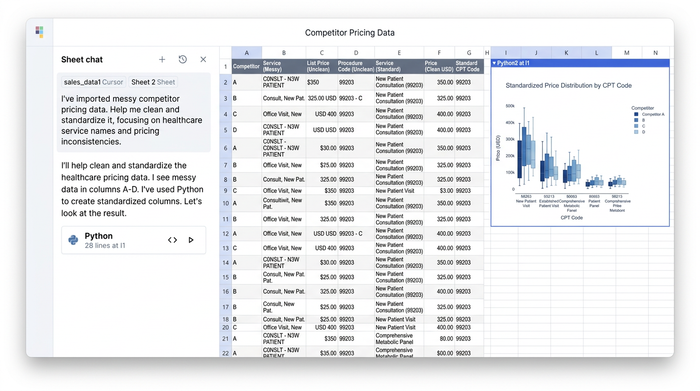
Rather than letting this information pile up across browser tabs and sticky notes, she brought it directly into Quadratic, structuring it as she found it: competitor name, service tier, price point, and positioning claims, all captured in a workspace built for the analysis rather than a running list of open tabs. Because Quadratic pairs an AI spreadsheet analyzer and web search with a spreadsheet grid in the same browser window, she could pull information and organize it in place instead of copying it somewhere else to clean up later.
Validation mattered just as much as collection. A single listed price is not reliable evidence, so she cross-checked pricing claims across multiple sources for each competitor before treating a figure as trustworthy. This is the messy, unglamorous part of competitive analysis that most guidance skips entirely, and it is exactly where a flawed market entry strategy in healthcare tends to originate: not from a bad framework, but from bad inputs.
Turning raw pricing data into a structured comparison
Once the raw data was gathered, the real work of quantitative data analysis was turning it into something usable. The analyst organized her findings into a clean comparison table: competitor across the rows, service tier and price down the columns, with positioning notes attached to each entry.
Quadratic's combination of spreadsheet structure and built-in AI made this reformatting fast rather than tedious. Inconsistent price formats (some competitors listed per-session rates, others quoted package pricing) could be cleaned and standardized quickly, and gaps in competitor offerings, like a service tier no one else in the market offered, became easy to spot rather than buried in a wall of text.
This is the "how" that most market entry guides leave out. It is not a complicated technique, but it is the difference between a competitive analysis that is a bulleted list of impressions and one that is an actual dataset you can query, sort, and trust.
Step 3: visualizing competitive positioning to find the underserved niche
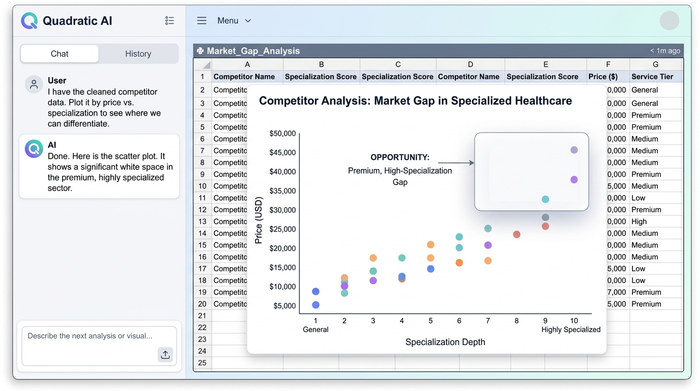
With a validated dataset in hand, the next goal was marketing data visualization: plotting competitors by price point against service specialization to expose where gaps existed in the local market.
The analyst built this visualization directly inside Quadratic, working from the same table she had just cleaned, without exporting anything to a separate tool for business intelligence and analytics or reformatting the data a second time. A positioning chart built with an AI chart generator plotting price against specialization depth made the shape of the market immediately clear in a way the raw table alone had not.
The insight that emerged was a genuine white space: a premium, highly specialized service segment with limited direct competition. Most local providers clustered around mid-range pricing with broadly similar service depth, leaving a clear opening at the premium, high-specialization end of the chart. This is precisely the kind of underserved market identification that strategic frameworks call for, but it only became visible because the underlying data had already been collected and validated. A chart built on unverified pricing would have shown a market gap that might not actually exist.
Step 4: aligning pricing strategy with the identified niche
Identifying the gap was only half the decision. The next question was where, specifically, to price the new service within that gap.
The validated competitor pricing data gave the analyst a defensible range to work from. She could see where "premium" pricing in the local market topped out, and where a new entrant might position above that ceiling without becoming an outlier that patients would perceive as unjustifiable. The distinction mattered: premium-but-justified pricing requires evidence that the market will bear it, as aggressive premium pricing strategies in healthcare without clear differentiation risk creating immediate openings for competitors and alienating exactly the acquisition-stage prospects the funnel depends on.
This decision also had to hold up against the funnel built in step one. A price set too high could suppress acquisition before prospects ever reached the application stage, while a price set too low could undermine perceived value and hurt retention over time, since patients who feel they got a bargain rather than a premium experience are less likely to return or refer others. Grounding the pricing decision in real market data, rather than instinct, is what turned this from a guess into a rationale she could present with confidence.
Step 5: building the launch strategy from verified insights
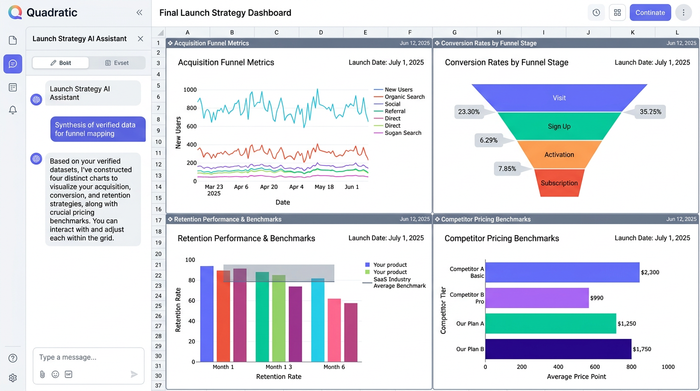
With the funnel defined, the competitive dataset validated, and the niche visualized and priced, the individual pieces came together into an actual launch strategy.
The resulting plan included positioning and messaging built specifically around the premium niche the data had revealed, rather than generic service-line language. It included funnel-specific tactics mapped to each stage: acquisition channels suited to a higher-consideration purchase, application and conversion improvements aimed at reducing friction in intake and eligibility, and retention touchpoints designed to reinforce the premium positioning after the first visit. And it included pricing backed directly by the competitor dataset, not an internal guess at what the market would tolerate.
This is what an executable market entry strategy in healthcare looks like when it is built on verified data rather than assumptions: every major decision, from where to position the service to what to charge for it, traces back to a specific piece of evidence rather than a hunch.
Common pitfalls in healthcare market entry (and how better data avoids them)
Most pitfalls in healthcare market entry are not strategic failures so much as data failures. A few show up repeatedly.
Relying on outdated or unverified competitor pricing is the most common. Healthcare pricing pages change, promotions expire, and a single unchecked listing can quietly distort an entire positioning decision.
Treating competitor analysis as only digital marketing metrics, while ignoring service-line and business strategy signals, is another. Traffic and engagement numbers say little about whether a competitor's actual service tiers and pricing leave room for a new entrant.
Skipping retention planning in favor of acquisition-only funnel thinking is a third. A launch strategy that only accounts for how patients arrive, without planning for how they stay, tends to underperform once the initial marketing push fades.
Finally, choosing a niche based on assumption rather than visualized, validated market gaps leads teams to chase openings that do not actually exist, or to miss ones that do because they were never mapped out clearly.
Each of these pitfalls has the same root cause: incomplete or unverified data. Better collection and validation practices, not more sophisticated frameworks, are usually what close the gap.
Key takeaways: executing a data-driven market entry strategy in healthcare
Strategic frameworks like funnel planning, competitive analysis, and niche identification are necessary, but they are not sufficient on their own. What separates a defensible launch plan from a hopeful one is a tactical process for collecting and validating real data at each step of the data analytics lifecycle.
Tools like Quadratic help close that gap by keeping research, cleaning, comparison, and visualization inside one workspace, so an analyst can move from scattered pricing pages to a structured, decision-ready dataset without losing accuracy along the way. That is the difference between a market entry strategy in healthcare built on impressions and one built on evidence, and it is the difference that ultimately determines whether a premium service launch succeeds.
If your team is planning a similar launch and wants to see how this kind of research-to-decision workflow comes together in practice, Quadratic is worth exploring as the workspace for that next step.
Use Quadratic for your market entry strategy in healthcare
- Gather and validate competitor data faster by using built-in AI search to pull pricing, service tiers, and positioning claims directly into your spreadsheet grid.
- Standardize inconsistent pricing formats, such as package rates and per-session fees, using AI-assisted data cleaning and flexible formulas.
- Map the competitive landscape visually with an AI chart generator to identify underserved market gaps and price your premium services with confidence.
- Connect directly to live operational and financial databases to model how different pricing structures impact your patient acquisition funnel and lifetime value.
- Collaborate with marketing, finance, and clinical teams in real time on a shared browser-based canvas to build a launch plan backed by verified evidence.
Ready to build a defensible, data-backed launch plan for your next healthcare service line? Try Quadratic
