
James Amoo, Community Partner
Apr 30, 2026

Table of contents
- Monarch Money for financial management
- Why users look for alternatives to Monarch Money
- The core decision: Evaluating automation vs. custom control
- How Quadratic fits your budgeting workflow
- Monarch Money vs Quadratic for money management
- Conclusion: Build your ideal financial workflow
- Frequently asked questions (FAQs)
Are you actively evaluating your personal finance software stack and feeling dissatisfied with your current setup? When searching for Monarch Money alternatives, the core decision is how much control you want over your financial workflow. Most users choose between two distinct paths: dedicated budget apps or spreadsheets.
The reality is that neither option is fully sufficient on its own. Budget apps often limit flexibility, while traditional spreadsheets like Excel and Google Sheets demand too much manual effort. This is why a new category of tools is emerging to bridge the gap. Platforms like Quadratic position themselves as the best alternative by combining automated data integration, spreadsheet-level flexibility, and AI-powered financial data analytics in a single environment. In this blog post, we’ll explore the limitations of traditional tools, what to look for in a modern solution, and how to build a more flexible personal finance system that aligns with your needs.
Monarch Money for financial management
Monarch Money is a comprehensive personal finance platform designed to give users a real-time view of their entire financial life. It allows you to connect bank accounts, credit cards, loans, and investment portfolios into a single dashboard, automatically aggregating balances and transactions. From there, users can build flexible budgets, track net worth, monitor cash flow, and generate visual reports that show exactly where money is going.
Monarch Money excels in providing both high-level financial visibility and detailed control over day-to-day finances. For example, a user can set monthly budgets for categories like groceries or rent, then compare actual spending against those targets in real time while also tracking long-term goals like a sinking fund for a home.
Why users look for alternatives to Monarch Money
Several common triggers push users to explore alternatives to Monarch Money. For some, it comes down to subscription fatigue and evaluating whether the recurring pricing model justifies the value. Others simply outgrow basic budgeting features and begin searching for a YNAB alternative. As your finances become more complex, you might find that restrictive app categories make it difficult to execute highly specific financial reporting.
Another major driver is the growing desire for multi-year net worth tracking. Standard apps often struggle to visualize long-term wealth building effectively, prompting many to search for a Monarch Money free alternative or a more robust analytical tool that can provide advanced forecasting.
A further limitation emerges when users want deeper customization and AI spreadsheet analysis capability. While Monarch Money provides flexible dashboards, it still operates within a predefined structure, which can make it difficult to build highly tailored financial models or integrate external data sources. For example, if you want to simulate different investment scenarios or create custom financial ratios, the platform may not offer the level of flexibility required for more advanced analysis.
Monarch Money still works exceptionally well for users who want a centralized view of their finances without excessive complexity. Its automated account syncing, intuitive interface, and strong visualization tools make it ideal for budgeting, tracking spending, and monitoring net worth at a high level. For individuals or households looking for a well-designed, all-in-one personal finance dashboard, it remains one of the most polished and user-friendly solutions available.
The core decision: Evaluating automation vs. custom control
Ultimately, the evaluation of a Monarch Money alternative or a Copilot Money alternative comes down to a fundamental trade-off: the convenience of automation versus the flexibility of full customization. Automated apps and financial reconciliation tools reduce friction by syncing transactions and presenting clean dashboards, but they often limit how deeply you can analyze or restructure your data. On the other hand, spreadsheets offer complete control over logic, structure, and analysis, but require significantly more manual effort to maintain.
Your level of financial complexity should guide this decision. For straightforward needs like tracking a monthly cash flow forecast or monitoring spending habits, an automated app may be entirely sufficient. However, as your financial life expands to include multiple income streams, investments, shared household budgets that require a couples budget template, or long-term planning, the limitations of fixed app structures become more apparent. In these cases, having the ability to build custom models and define your own spreadsheet automation framework becomes increasingly valuable.
Subscription fatigue also plays a critical role in the evaluation process. Users must weigh the recurring cost of dedicated apps against the hidden time cost of maintaining spreadsheets manually. While apps charge financially for convenience, spreadsheets demand ongoing effort and discipline. The right choice depends on whether you prioritize saving time through automation or gaining deeper insight and control through customization.
How Quadratic fits your budgeting workflow
For users evaluating alternatives to Monarch Money, the core limitation often comes down to flexibility. Monarch offers an aggregated view of your finances, but its predefined structures can restrict how deeply you can customize your budgeting logic or extend your analysis. Quadratic takes a different approach by turning your budgeting system into a fully programmable workspace. Let’s explore the features of Quadratic in detail:
Aggregate all financial data into a single live workspace
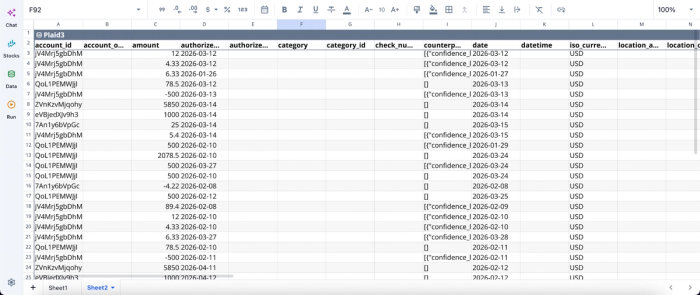
Quadratic connects directly to bank accounts, credit cards, and brokerage platforms via its Plaid integration, continuously pulling transaction and balance data into a unified grid. This eliminates the need to rely on periodic syncs or siloed dashboards.
By centralizing your financial data, you gain a real-time foundation for analysis. Every transaction, account balance, and investment update feeds into the same environment, ensuring your budgeting decisions are always based on current information.
Build adaptive budgeting systems that reflect real-life cash flow
Rather than relying on fixed categories, Quadratic enables you to construct dynamic budgeting frameworks that adjust to variable income, irregular expenses, or multi-account structures. You can define rules for allocating funds, handling rollovers, and managing shared expenses, making it the best expense tracker for small business owners.
This flexibility is particularly valuable for freelancers needing an expense and income tracker, entrepreneurs, or households with complex financial flows. Your budgeting system becomes responsive rather than restrictive.
Extend your financial system with Python and SQL
Quadratic includes native support for Python and SQL, allowing you to implement advanced financial logic such as forecasting models, custom categorization engines, or scenario simulations.
This capability unlocks a level of analytical depth that traditional budgeting apps cannot match. You are not limited to predefined features; you can build exactly what your workflow requires.
Automate recurring financial workflows
Quadratic allows you to automate data updates and recurring calculations via its scheduled tasks feature. Your budgeting system stays current without requiring constant manual input.
This reduces operational overhead while maintaining accuracy. You get the benefits of automation without sacrificing control.
Use AI to interpret spending behavior and optimize decisions
Quadratic’s AI personal finance capabilities go beyond simple categorization. You can ask it to identify trends, flag unusual transactions, or summarize spending patterns across time periods.
This transforms raw transaction logs into actionable insights. Instead of manually reviewing expenses, you can quickly understand where inefficiencies exist and how to improve your financial habits. Let’s see how this works.
First, I connect to my bank account via Quadratic’s Plaid integration:
Then I can proceed to analysis using text prompts:
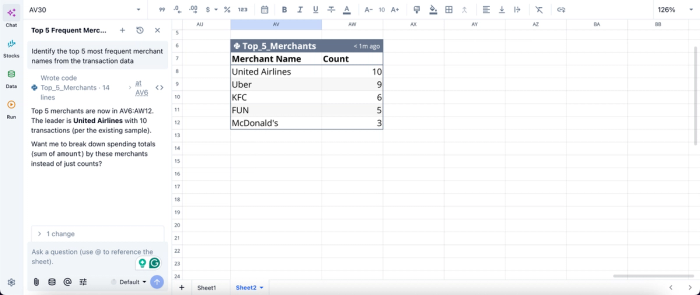
In this image, I ask Quadratic AI to “Identify the top 5 most frequent merchant names from the transaction data.” It instantly generates a table that shows the top 5 merchants. No code or formula required, just simple text prompts.
Create real-time dashboards for financial visibility
Quadratic allows you to generate financial data visualizations and custom dashboards that visualize spending, savings rates, category breakdowns, and net worth progression. These dashboards update automatically as new data flows in.
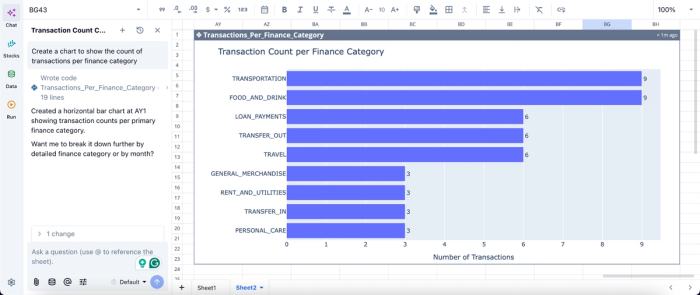
This provides immediate clarity into your financial position. You can track progress toward goals and make adjustments without waiting for end-of-month summaries. Visualization in Quadratic can also be done by using text prompts:
In this image, I ask Quadratic AI to “Create a chart to show the count of transactions per finance category.” In seconds, it creates a chart that displays the transaction count per finance category, helping non-technical users to interpret their data with ease.
Collaborate on shared financial systems
Quadratic supports real-time collaboration, enabling multiple users to work on the same budgeting model simultaneously. This is especially useful for couples, families, or financial advisors.
Adopting a collaborative analytics platform for finance improves transparency and alignment. Everyone involved in financial decision-making can see the same data and contribute to the same system.
Monarch Money vs Quadratic for money management
In this section, we’ll compare Monarch Money and Quadratic using key metrics. This will help you select the best tool for your workflow.
| Metric | Monarch Money | Quadratic |
|---|---|---|
| Data integration (accounts & external sources) | Strong account aggregation, but limited support for integrating external or non-financial datasets | Connects to banks, credit cards, brokerages, APIs, and external datasets in one unified workspace |
| Flexibility | Structured budgeting system with customizable categories, but limited control over underlying logic | Fully customizable budgeting frameworks using formulas, Python, and AI-driven rules tailored to any financial scenario |
| AI-powered financial insights | Basic automation and categorization; limited AI-driven analytical depth | Advanced AI for transaction analysis, anomaly detection, forecasting, and custom financial queries |
| Investment & net worth analysis | Good net worth tracking and investment visibility, but limited analytical customization | Deep investment tracking with custom portfolio analytics, scenario modeling, and integrated net worth dashboards |
| Workflow automation | Automated syncing and rules, but workflows remain constrained to app-defined logic | Fully programmable automation for categorization, calculations, and financial workflows |
| Financial visualization | Clean, prebuilt dashboards with limited flexibility for custom reporting | Fully customizable dashboards and dynamic visualizations tied to live, multi-source data |
Conclusion: Build your ideal financial workflow
Choosing Monarch Money alternatives is about finding the exact level of control and automation that fits your household's unique needs. You no longer have to compromise between automated data entry and advanced financial analysis. By bringing your live financial data into a flexible workspace, you can design a system that works for you, rather than adapting your finances to fit a rigid app.
Quadratic enables you to seamlessly connect your financial accounts and manage your entire financial workflow in one place. With automated data syncing, AI-driven analysis, and interactive visualizations, it transforms raw transaction data into actionable insights. Try Quadratic for free.
Frequently asked questions (FAQs)
Why do users look for Monarch Money alternatives?
Users often seek Monarch Money alternatives due to subscription fatigue or outgrowing basic budgeting features as their finances become more complex. Many also desire more robust tools for advanced analysis, such as multi-year net worth tracking, which standard apps may not support adequately.
What is the main tradeoff when choosing an alternative to Monarch Money?
The core decision when evaluating an alternative to Monarch Money involves balancing convenience against custom control. Dedicated apps offer automation but lack flexibility for complex scenarios, while traditional spreadsheets provide total customization but require extensive manual data entry.
How does Quadratic address the limitations of typical Monarch Money alternatives?
Quadratic merges automated financial data feeds with a flexible analytical spreadsheet. This allows users to connect live bank, credit card, and brokerage data automatically, then apply native Python, SQL, and formulas for custom financial analysis without manual data entry.
