
James Amoo, Community Partner
Apr 30, 2026

Table of contents
Managing personal finances often forces a frustrating choice: conform to the rigid rules of a budgeting app or spreadsheet, or spend hours manually updating a custom spreadsheet. If you find yourself constantly wrestling with pre-set categories or wishing you could analyze your spending in a specific way, you are not alone.
The good news is that you no longer have to choose between automated bank syncing and spreadsheet automation. Quadratic stands out as the best YNAB alternative by combining automated data processing, spreadsheet flexibility, and AI-powered financial data analytics in a unified environment. In this article, you’ll learn where traditional budgeting apps fall short, what to look for in a modern alternative, and how to build a smarter personal finance workflow that evolves with your financial goals.
YNAB for money management
YNAB (You Need A Budget) is a personal finance application built around a proactive budgeting philosophy. Instead of simply tracking past spending, YNAB encourages users to assign every dollar a specific job, helping them plan and take control of their finances. Its methodology-driven approach is a key differentiator, guiding users toward better financial habits rather than just presenting raw data.
YNAB excels in helping individuals build discipline and clarity around day-to-day money management. For example, a user can allocate their monthly income across categories like rent, groceries, savings, and discretionary spending, ensuring that every expense is planned. However, while it is highly effective for structured budgeting, its predefined framework can feel limiting for users who want to run more complex financial analyses, such as long-term investment modeling or highly customized financial reporting.
Why seek alternatives to YNAB?
Budgeting apps are excellent for building foundational financial habits, but they enforce a specific methodology. As household finances grow more complex, users often outgrow these strict envelope-style rules. You might need to track shared expenses across multiple partners or build accounting dashboards that a standard app simply cannot generate. This is exactly why power users begin searching for alternatives to YNAB.
Historically, this search presented a difficult trade-off. Traditional apps offer the immense convenience of automated bank synchronization, while spreadsheets offer the absolute control of infinite customizability. Most people hesitate to abandon their budgeting apps because they dread losing the automatic transaction imports and intelligent bank transaction categorization that keep their finances up to date. Finding a true alternative to YNAB means finding a way to bridge this gap between convenience and control.
As expectations evolve, users are increasingly looking for systems that go beyond budgeting into full financial management and analysis. This includes the ability to model future scenarios, integrate multiple income streams, and create a personal finance dashboard that reflects their exact financial priorities. The ideal solution is about building a flexible environment that adapts to your financial life rather than constraining it.
Why a traditional or free YNAB alternative often fails
When frustration peaks, many users immediately download a static spreadsheet template to manage their household finances, but a better approach involves comprehensive personal finance tracking. While a YNAB free alternative might seem appealing at first, it usually introduces a new set of problems. The biggest trap of the traditional spreadsheets like Excel and Google Sheets is the sheer burden of manual data entry.
Logging every grocery run, utility bill, and subscription by hand becomes exhausting. This manual upkeep is the primary reason users abandon their custom setups and return to rigid apps. Furthermore, a standard free alternative to YNAB comes with significant technical limitations. Relying on static CSV exports leads to stale data, while complex templates are prone to broken formulas and zero automated categorization. Without live data feeds, a YNAB alternative free of cost often ends up costing you hours of tedious administrative work each month.
Over time, this approach also limits your ability to gain meaningful insights from your data. Without automation and structured data pipelines, it becomes difficult to track trends or make informed financial decisions. What starts as a simple workaround quickly turns into a fragmented system that lacks reliability and scalability, reinforcing the need for an AI spreadsheet analysis tool that combines automation with flexibility.
Automating transaction sync and categorization
The true power of a connected spreadsheet lies in its ability to replace manual data entry with automated data feeds. Instead of typing out individual purchases, your transactions flow seamlessly from your checking, credit, and brokerage accounts directly into your workspace, making transaction tracking effortless.
Once the data is in the grid, a hybrid setup allows you to apply data transformation logic to automatically categorize recurring household expenses. You can write specific formulas or use basic code to ensure your favorite coffee shop is always tagged as a dining expense, or that your monthly utility bills are automatically sorted into fixed costs. This level of automation places connected spreadsheets ahead of other YNAB alternatives, saving you hours of manual sorting while ensuring your custom budgeting structure is always populated with accurate data.
How Quadratic fits your hybrid budgeting workflow
For users exploring alternatives to YNAB, the challenge is often balancing discipline with flexibility. YNAB enforces a strong methodology, but power users eventually hit limits when they want deeper customization or more advanced analysis. Quadratic bridges this gap by combining automated financial tracking with a fully spreadsheet-native environment. Let’s explore the features of Quadratic for money management.
Sync and unify all financial accounts in one system
Quadratic integrates directly with banking, credit card, and brokerage accounts via Plaid integration. Transactions, balances, and cash flow data flow automatically into a centralized grid.
This eliminates the fragmentation common in personal finance setups. Instead of switching between apps, your entire financial ecosystem is consolidated into a continuously updated workspace.
Design envelope-style budgets with custom logic
Quadratic allows you to replicate and extend envelope budgeting systems like YNAB using formulas, rules, and scripts. You can define how funds are allocated, rolled over, or rebalanced across categories.
This preserves budgeting discipline while removing rigidity. Your system adapts to irregular income or complex financial goals without breaking.
Build dynamic net worth and cash flow models
Quadratic enables you to track assets, liabilities, and cash flow in real time using live data inputs. You can construct detailed net worth trackers and forecast future financial positions.
This provides a forward-looking perspective that most apps lack. Your financial system becomes a planning tool, not just a historical record.
Combine day-to-day spending with long-term investments
Quadratic allows you to integrate stock market data directly into your budgeting workflow, unlike traditional methods of getting stock quotes in Excel. You can track portfolio performance alongside savings goals and monthly expenses.
This view helps you make better trade-offs between spending, saving, and investing. All financial decisions are informed by a complete picture.
Build advanced financial logic with Python and SQL
Quadratic includes native support for Python and SQL, allowing you to create sophisticated categorization systems, forecasting models, and financial simulations.
This unlocks a level of control that traditional apps cannot offer. You can implement highly specific logic tailored to your personal financial strategy.
Use AI to audit spending and detect inefficiencies
Quadratic’s AI can analyze transaction data to identify overspending patterns, recurring charges, or anomalies in your financial behavior. You can also prompt it to generate summaries or suggest optimizations.
This transforms budgeting from a tracking exercise into an optimization process. Instead of just assigning dollars, you gain insight into how effectively those dollars are being used. Let’s see how this works.
First, I connect to my bank account via Quadratic’s Plaid integration:
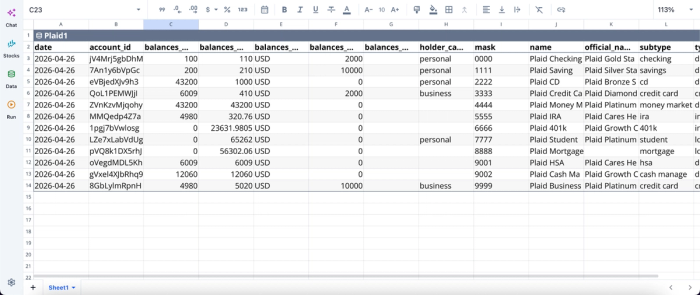
We can then begin analysis after this by asking questions using text prompts:
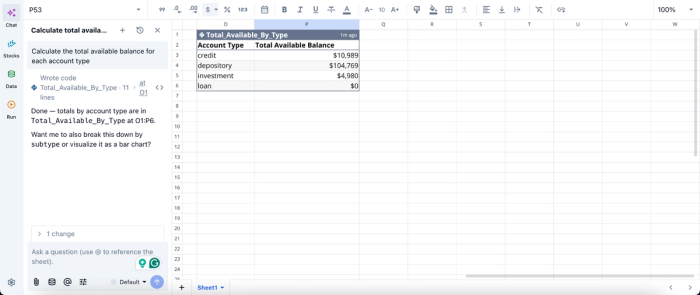
Here, I ask Quadratic AI to “Calculate the total available balance for each account type.” It generates a table that gives a breakdown of the balance for each account type. Users can get key insights on their personal finances by simply asking questions.
Visualize financial health with real-time dashboards
Quadratic enables you to create fully customizable financial data visualizations and dashboards that track spending trends, savings rates, and net worth over time. These visuals update automatically as new data flows in.
This makes it easier to interpret complex financial data and monitor progress toward goals without manual updates. Visualization in Quadratic can also be done by using text prompts:
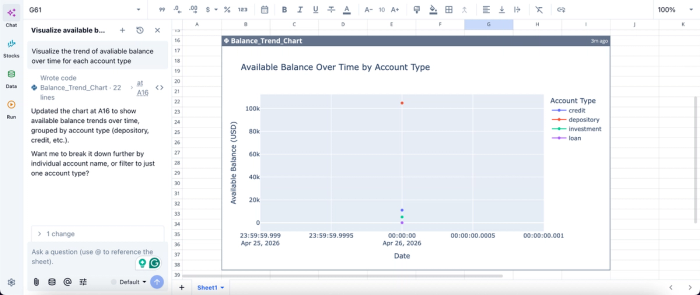
In this image, I ask Quadratic to “Visualize the trend of available balance over time for each account type.” In seconds, it creates a chart that visualizes the balance over time by account type.
Collaborate on shared financial plans
Quadratic supports real-time collaboration, making it ideal for couples, families, or advisors managing finances together. Multiple users can view, edit, and validate the same financial model.
This shared visibility improves accountability and alignment, especially for joint budgeting and long-term planning.
YNAB vs Quadratic for money management
This section will compare YNAB and Quadratic using key financial metrics.
| Metric | YNAB | Quadratic |
|---|---|---|
| Budgeting flexibility | Strict zero-based budgeting framework with limited ability to modify underlying logic | Fully customizable budgeting systems using formulas, Python, and AI-driven logic tailored to any financial scenario |
| Data integration (banks, investments, external sources) | Primarily focused on bank account syncing; limited support for broader financial data integration | Connects to banks, credit cards, brokerages, APIs, and external datasets in one unified workspace |
| AI-powered financial analysis | No native AI analysis; relies on manual review and categorization | Advanced AI for transaction insights, forecasting, anomaly detection, and custom financial queries |
| Investment & net worth tracking | Basic net worth tracking; lacks robust investment analytics | Deep investment tracking with customizable models, portfolio analytics, and integrated net worth dashboards |
| Financial visualization | Predefined reports with limited customization and analytical depth | Fully customizable dashboards and real-time visualizations across spending, savings, and investments |
| Automation | Requires consistent manual input and active budgeting to function effectively | Fully automated data refresh, categorization rules, and programmable financial workflows |
Conclusion
Choosing the right YNAB alternative ultimately comes down to how much control and depth you want in your financial system. While YNAB remains an excellent tool for building discipline through structured budgeting, its rigid framework can limit users as their financial lives become more complex. A hybrid approach offers a more scalable path forward. Quadratic exemplifies this shift by unifying real-time data, spreadsheet flexibility, and advanced analytics into a single environment, allowing users to move beyond static budgeting into dynamic financial management. Try Quadratic for free.
Frequently asked questions (FAQs)
Why do people look for a YNAB alternative?
Many users seek a YNAB alternative because traditional budgeting apps can become too rigid as personal finances grow more complex. They desire more control over custom categories, specialized reports, and managing irregular income without sacrificing the convenience of automated financial tracking.
How does Quadratic serve as a powerful YNAB alternative for custom budgeting?
Quadratic provides a flexible YNAB alternative by combining automated bank syncing with the full control of a spreadsheet environment. It leverages native Plaid integration for live cash flow data and allows users to apply Python, SQL, or standard formulas for advanced categorization and personalized financial analysis. The built-in AI assistant also helps clean and transform transaction data for deeper insights.
What is a hybrid connected spreadsheet for personal finance?
A hybrid connected spreadsheet integrates direct bank syncing into a flexible spreadsheet environment, bringing live financial data directly into a customizable grid. This approach offers the convenience of automated transaction imports alongside the absolute control to design custom budgeting rules and generate personalized reports. It bridges the gap between traditional apps and static spreadsheets, offering a superior alternative to YNAB for power users.
