
James Amoo, Community Partner
May 7, 2026

The interest in using artificial intelligence for financial data analytics is growing rapidly. Investors and analysts are actively exploring how AI finance tools can streamline their research and data analysis. However, there is a natural skepticism surrounding any generic AI stock picker that promises guaranteed returns or hides its methodology.
Instead of relying on black-box algorithms, investors should build verifiable workflows. By designing your own system, you maintain full transparency over your data, logic, and assumptions. This article covers the flaws of generic tools, the value of a human-in-the-loop methodology, and a step-by-step guide to building a custom stock screener tailored to your unique investment strategy.
The hidden risks of generic AI stock picks
Relying on opaque algorithms for financial decisions carries inherent risks. The best AI stock picker does not hide its underlying mechanics. This black-box logic is dangerous because analysts cannot inspect the mathematical weights or fundamental assumptions driving the results.
Generic large language models might generate confident AI stock picks, but they lack the context of your personal risk tolerance. A one-size-fits-all approach rarely aligns with a unique stock market analysis. Without the ability to verify the data or see the math behind the rankings, you are essentially flying blind in a market that demands precision and accountability.
Quadratic addresses this problem by making the entire analytical process transparent and customizable. Instead of relying on hidden logic, you can define your own screening criteria, inspect the underlying data, and build models using Python or spreadsheet formulas within a single environment. This ensures that every output is explainable and aligned with your specific investment strategy.
Why "human-in-the-loop" is the best approach to AI stock picking
The ideal balance between artificial intelligence and human financial expertise is a human-in-the-loop methodology. In this model, AI is utilized to accelerate data exploration and conduct initial screening rather than making unverified investment decisions.
When it comes to AI stock picking, the analyst must remain in control. The technology serves as a powerful assistant, quickly retrieving financial statements, news, and fundamentals. The human expert then verifies the data integrity and manually validates the model's output. This collaborative workflow ensures that you benefit from the speed of spreadsheet automation while applying the critical thinking required for sound financial forecasting.
An additional advantage of this approach is its adaptability across different market conditions. Human oversight allows analysts to adjust assumptions and incorporate qualitative factors that automated systems may overlook. This ensures that your data analytics strategy remains grounded and resilient, rather than rigidly dependent on static model outputs.
Core phases of a custom AI stock research workflow
Building a custom DIY screener breaks the financial modeling pipeline down into practical steps. The primary goal across is to build a system that remains completely transparent and inspectable at every stage, aligning with the principles of Explainable AI (XAI).
Defining custom screening criteria
The first step is translating your personal investment thesis into quantifiable screening rules. An AI needs specific parameters to process information effectively. You must transition from broad traditional financial frameworks to strict criteria that algorithms can help filter or rank.
The user, not the AI, must dictate the risk tolerance, target metrics, and sector focus. Whether you are looking for undervalued dividend stocks or high-growth tech companies, clearly defining these parameters ensures the AI searches for exactly what fits your strategy.
Sourcing and verifying market data
Once your criteria are set, you can use AI to pull fundamentals, financial statements, and recent market news. Having direct access to this raw data is critical. If an AI generates a summary or insight, you need to be able to verify the underlying numbers.
Analysts should cross-reference AI outputs against traditional data feeds, databases, and APIs. This manual check ensures complete accuracy and protects your workflow from hallucinations or outdated information.
Building a personalized ranking model
With verified data in hand, you can structure a custom scoring system. This model ranks assets based on the criteria you defined earlier. The key is to keep the mathematical logic entirely visible so you understand exactly why a specific asset is ranked highly.
This transparent scoring method stands in stark contrast to the opaque outputs typical of generic web-based screeners. If you use a standard free AI stock picker, you rarely get to see the formula determining the score. A personalized model guarantees that every calculation remains inspectable.
Building your verifiable workflow in Quadratic
For investors seeking the best free AI stock picker experience, a custom-built transparent platform is the superior alternative to generic tools. Quadratic provides an ideal environment for bridging the gap between code-level customization and spreadsheet familiarity. It allows analysts to build an AI-assisted screener without losing visibility into the underlying logic.
Ingest and reconcile multi-source market data in one model
A verifiable stock picker begins with data integrity. Quadratic allows you to connect directly to real-time stock market data, including market price feeds, company fundamentals, macroeconomic indicators, and even alternative datasets. Instead of stitching together APIs and resorting to CSV data analysis, your entire dataset is consolidated into a structured grid.
This layer ensures that every input into your model is traceable and consistent. You can align pricing data with financial statements and external signals without worrying about schema drift or fragmented pipelines.
Automate data updates and model execution
A verifiable workflow must also be repeatable. Quadratic supports scheduled updates that automatically refresh your data sources and update your dashboards without manual intervention. This ensures that your stock picker remains current as market conditions change.
By automating the full pipeline, you eliminate the operational overhead that often introduces inconsistencies. Your model becomes a continuously running system rather than a one-off analysis.
Build custom factor models and screeners with Python
A serious stock picker requires more than simple filters. Quadratic enables you to implement advanced factor models directly in the grid using native Python and SQL. You can construct multi-factor scoring systems that incorporate momentum and volatility signals, all within the same environment as your raw data.
This capability also allows you to seamlessly combine vectorized computations with intuitive cell-based logic, ensuring your model remains both powerful and accessible.
Generate and refine stock ranking models with AI-assisted logic
Rather than treating AI as a black-box signal generator, Quadratic positions it as a built-in assistant for building transparent ranking systems. You can prompt the AI to generate Python code that calculates factor-based scores, ranks stocks by valuation or growth metrics, or constructs composite indicators based on your defined strategy.
Crucially, this logic is not hidden. Every generated script is fully editable, allowing you to refine assumptions and validate calculations. This transforms AI agents for data analysis from a source of opaque predictions into a tool for accelerating structured financial modeling while maintaining full control over methodology.
Let’s see how this works using the stock research report template in Quadratic:
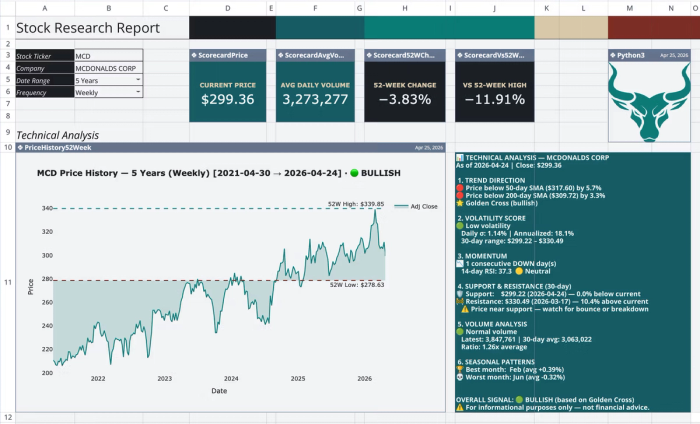
This template provides a single-ticker financial research dashboard for comprehensive financial reporting, organized across four sheets. It automates the retrieval of historical price data and the calculation of technical indicators directly within the spreadsheet. Users can also conduct custom analysis using text prompts:
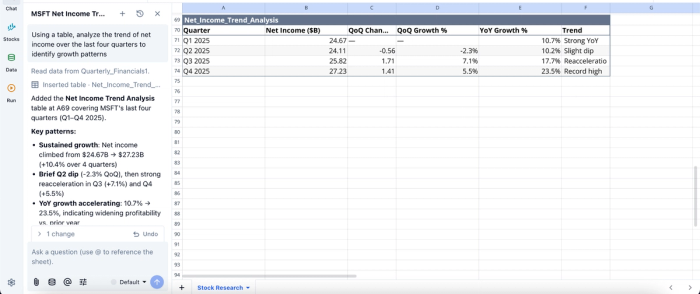
In this image, I prompt Quadratic AI, “Using a table, analyze the trend of net income over the last four quarters to identify growth patterns.” It instantly generates a table that gives insights into the net income trend analysis.
Visualize factor performance and model outputs in real time
Once your model is constructed, you need to evaluate how it behaves. Quadratic allows you to build dynamic finance data visualizations directly on top of your ranking system. You can chart factor performance and monitor how selected stocks evolve.
These visualizations update automatically as new data flows in, enabling continuous evaluation of your model’s effectiveness. This makes it easier to identify drift and refine your strategy based on observable outcomes rather than static snapshots. Users can also generate interactive visualizations in Quadratic using text prompts:
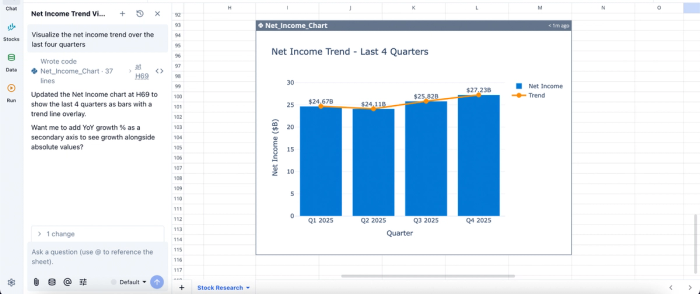
In this image, I ask Quadratic AI to “Visualize the net income trend over the last four quarters.” In seconds, it generates an interactive visualization that gives visual insights into the net income trend for the last 4 quarters.
Collaborate on research and validate results collectively
Stock selection is rarely a solo exercise in professional environments. Quadratic’s real-time collaboration capabilities allow multiple analysts to work within the same model, reviewing logic and validating results together.
Since all code, data, and outputs are shared in a single collaborative analytics platform, teams can align on methodology without relying on fragmented tools or version-controlled scripts.
Conclusion
The growing interest in building an AI stock picker reflects a shift away from black-box tools toward research-driven workflows. Rather than relying on opaque algorithms, this approach emphasizes defining clear screening criteria and validating reliable data.
Quadratic enables this transition by providing a unified environment to build, automate, and validate custom stock screening workflows. With integrated data ingestion, Python-powered modeling, real-time visualizations, and collaborative features, Quadratic transforms this process into a transparent and auditable system. Try Quadratic for free.
Frequently asked questions (FAQs)
Why is a human-in-the-loop approach recommended for AI stock picking?
A human-in-the-loop methodology leverages AI to accelerate data gathering and initial screening, while keeping the human analyst in control for critical verification. This ensures data integrity and allows expert judgment to validate the AI's output, preventing reliance on unverified or context-lacking AI stock picks.
How does Quadratic help build a transparent AI stock picker workflow?
Quadratic provides an environment where users can build custom AI-assisted stock screeners with full visibility into data, code, and logic. It allows analysts to use AI to generate Python data pipelines, pull rich financial datasets directly into a spreadsheet, and inspect every calculation to ensure a verifiable AI stock picker.
What makes a custom AI stock picker superior to a generic free AI stock picker?
A custom AI stock picker provides complete control over screening criteria, data sources, and ranking logic, ensuring the system aligns perfectly with your unique investment strategy. Unlike a generic free AI stock picker, a personalized model guarantees transparency, allowing you to audit every step and trust the rationale behind your AI stock picks.
